The Ecuadorians rejected the referendums of President Noboa, who hoped to thus help the Americans

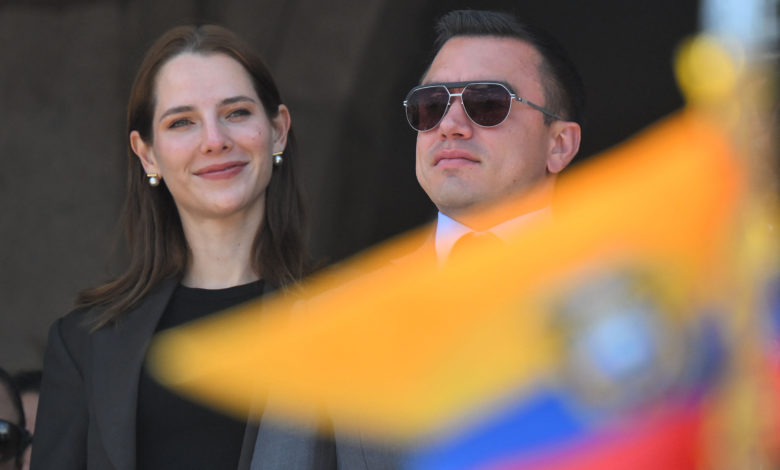
Ecuadorians rejected the re-establishment of foreign military bases and the drafting of a new Constitution on Sunday, according to the first results of a referendum, a defeat for President Daniel Noboa, an ally of the United States, reports AFP.
Some 61 percent of voters voted against lifting the ban on foreign bases, and 62 percent voted against appointing an assembly tasked with drafting a new Constitution, according to partial results released by the National Electoral Council.
“We respect the will of the Ecuadorian people,” Daniel Noboa wrote on X after his defeat in the referendum, adding that “his commitment does not change, but strengthens.”
Americans will not be able to have bases in Ecuador
This negative vote will prevent the US military from returning to its former military base in Manta, on the Pacific coast, used in the past by Washington for anti-drug operations.
The rejection of the referendum on foreign bases comes at a time of high tensions in Latin America, with a large US military deployment in the Caribbean Sea and the Pacific, where the United States is conducting airstrikes against what it says are drug-carrying ships.
In exchange for Washington's support, Daniel Noboa hoped to get American help to fight the gangs and cartels that plague his country, an exit point for cocaine produced in neighboring Colombia or Peru.
The president also intended to draft a new Constitution, believing that the current one was too lenient on criminals.
Noboa announced during the referendum the arrest of a cartel leader
The vote took place in a context of unprecedented violence in Ecuador, where Noboa promotes a firm policy against organized crime, while the judiciary has blocked several of his initiatives considered contrary to fundamental rights.
Nearly 14 million Ecuadorians were expected at the polls to answer “yes” or “no” to four questions in this mandatory referendum. In addition to bringing back foreign military bases banned since 2008 and drafting a new Constitution, they had to decide whether to end public funding of political parties and reduce the number of parliamentarians.
Shortly after the vote began, President Noboa announced on X the capture of the head of Ecuador's main drug-trafficking group, “Pipo” Chavarria.
The Minister of the Interior, John Reimberg, stated, on the same platform, that the arrest took place in Spain.
Ecuador, the country with the highest crime rate in South America
“Drug trafficking is so present in the Ecuadorian state that we may need the help of the foreign army,” Andrés, a 43-year-old seller, told AFP.
The country is going through an unprecedented security crisis, with a homicide rate of 39 per 100,000 inhabitants, the highest in Latin America, according to think tank Insight Crime.
And according to calculations by the Ecuadorian Organized Crime Observatory, the figure would reach 52 in 2025, an unprecedented level and double the regional average.
“There is neither healthcare nor security,” Ecuadorian Ana Manotoa said after voting in the San Miguel del Común neighborhood north of Quito, the epicenter of recent indigenous demonstrations against rising diesel prices. Her vote was one of “rejection of the government”, said this 36-year-old woman.
“Some aspects of the referendum are advantageous, others less so,” said Carlos Vaca, a 60-year-old porter who favors reducing the number of deputies, but rejects a new Constitution and military bases, considered “deceptive.”
In power since November 2023, Noboa has been fighting organized crime by deploying the military on the streets and in prisons, sweeping operations in drug-trafficking strongholds and frequent states of emergency, criticized by human rights organizations.
Since Donald Trump's return to the White House, Ecuador has become one of Washington's main allies in the region, supporting its military deployment in the Caribbean Sea that has resulted in the killing of at least 80 suspected drug traffickers.