“Invasion of wolves”. China is testing combat robots as part of exercises for a possible amphibious operation on Taiwan


Images broadcast by Chinese state television show robotic units advancing alongside People's Liberation Army (PLA) soldiers, simulating a landing on enemy territory.
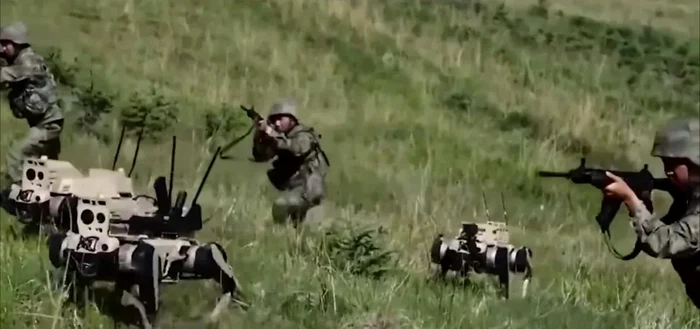
Robot wolves pave the way for Chinese soldiers/PHOTO:X
According to official sources, these systems – dubbed “robot wolves” – are powered by artificial intelligence and can be equipped with automatic rifles. They can operate autonomously on rough terrain and are intended to cross “no man's land” areas previously considered too dangerous for troops.
According to the data presented by the PLA, the robots can be controlled from a distance of up to 2 kilometers and can advance 200 meters in less than 30 seconds. Beijing claims the systems have a 92% first-strike accuracy.
Each unit weighs about 70 kilograms and can carry up to 20 kilograms of equipment, including ammunition, medical kits or logistics materials. The robots can operate for more than two hours in continuous combat, operate for 30 minutes underwater and cover a distance of about 10 kilometers.
Part of a modernized military strategy
The robots are part of Beijing's broader effort to modernize its military doctrine, now geared toward autonomous technologies and cyber warfare. The new tactics aim to reduce the risk to human soldiers, replacing Maoist-era “human wave” attacks with coordinated operations between drones, robots and artillery.
According to Chinese media, each robot team includes a reconnaissance “wolf”, two armed robots and one for carrying ammunition. In recent exercises, they have been supported by artillery and drone fire.
Reservations from experts
Western military analysts warn, however, that the effectiveness of these machines remains limited. They argue that robots lack robust defensive capabilities and depend on direct support from human troops, especially in complex combat conditions.
The robots were first shown publicly at an air show last year and later at a military parade in Beijing attended by the leaders of Russia and North Korea.
Modernization of the Chinese Armed Forces
President Xi Jinping has overseen a sweeping modernization of China's military in recent years aimed at closing the gap with the United States and Russia. In addition to autonomous technologies, China has significantly expanded its naval capacity, recently launching its largest aircraft carrier, the 80,000-ton Fujian.
The ship officially entered active service with the People's Liberation Army Navy on Hainan Island, cementing China's position as the world's second largest naval power in direct competition with the United States.