Dialogue with the former Bosnian teammate of Hagi and Popescu in Barcelona: “When I saw what Gica did in training, I stepped aside!” + What he thinks will happen in Bosnia

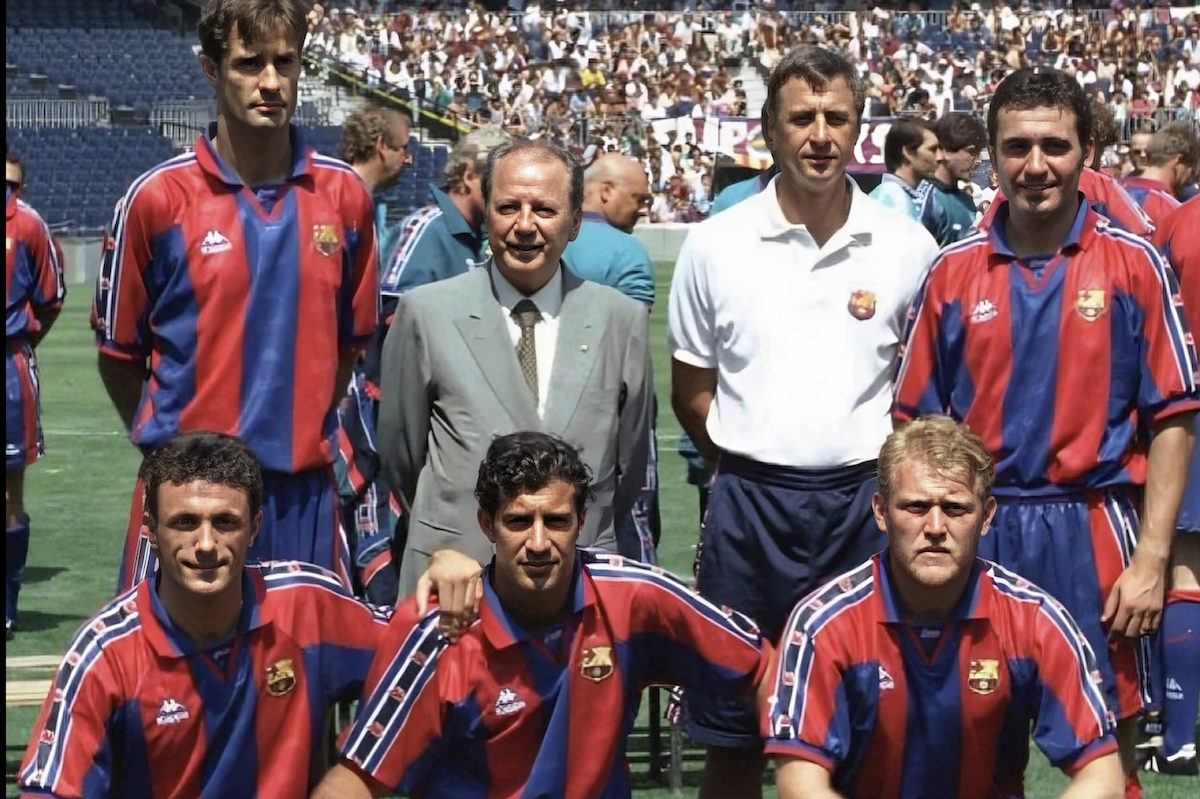
Mehmed “Meho” Kodro is a former Bosnian footballer with strong ties to Romania. He played at Barcelona alongside Gică Hagi and Gică Popescu, and at Alaves he had Cosmin Contra as his teammate. And before Bosnia – Romania, he talked to Gazeta Sporturilor, both about the match and about his former colleagues.
- Bosnia – Romania, the penultimate match of the WC 2026 preliminaries, will be played on Saturday, November 15, from 21:45.
- The Zenica duel will be liveTEXT on GSP.ro, with real-time information from Gazeta Sporturilor reporters present at the stadium, and live on Prima TV
In the summer of 1995, a year after Barcelona brought Gică Hagi, Gică Popescu and Meho Kodro arrived at the Catalan formation at the same time. The former striker came from Real Sociedad and was leaving after a season in which he scored 44 matches and scored 15 goals. But during the season he spent at Camp Nou, he formed a beautiful friendship with Hagi and Popescu, of which he now speaks in superlative terms. Later, in 1999, he arrived at Deportivo Alaves, where he played alongside Cosmin Contra, who immediately impressed him.
Kodro, memories with Hagi and Popescu at Barcelona: “When I saw how he took free kicks, I said I don't dare to take the ball anymore”
– Hello, Mr. Kodro! Thanks for the interview! what are you doing What are you up to these days?
– I spend my time between Spain and Bosnia. In Bosnia, I help my team that I grew up with, Velez Mostar. I help the management a bit, I try to contribute to the growth of the team. When I stay in Spain, in San Sebastian, life is quieter. In Bosnia it is less peaceful.
– How is football in Bosnia?
– Grow, grow. The championship is better organized. This season there are fewer teams than last year and that has helped raise the level. Before there were 12 teams, now there are 10. There is more quality and more competitiveness. Football is not at a very high level, but it is growing. I hope that in the future we will be better prepared and be able to face the duels with teams from other championships. Today, any team that is somewhat organized can be competitive. We, in the Balkans, have always had talent. Organization was lacking. And that is being worked on now.
– What was it like when you moved from Yugoslavia to Spain? How big was the change?
– It was a natural step. I left more than 30 years ago, and then the championship in Yugoslavia resembled the one in Spain. Football was very good. And my team, Velez Mostar, was one of the best. And a transfer to Spain was not that difficult to achieve. Now the difference is much bigger. And it is complicated for a player from the Balkan area to go directly to a championship like that of Spain. Especially from a league like the one in Bosnia. It wasn't a shock to me then. I didn't feel that. There was a difference in language, but I quickly got over it.
– Then, you arrived in Barcelona, in 1995. With Gică Popescu.
– Yes, yes. Hagi was already there, he had come a year before. I came in the same summer as Gică Popescu. And with Luis Figo and Robert Prosinecki.
– How was that moment? What was it like to play at Barcelona under the great Johan Cruyff?
– It was something very big. But then the famous Dream Team, which won the Champions Cup, was over. The cycle is changing. Then we came. Barcelona was at the highest level in the world. They were very big players.
– And there you were colleagues with Gică Hagi and Gică Popescu.
– As players, they were at the highest level. Both were proud of their country. And they did a lot for world football. I knew Hagi before we were colleagues. He was very good, it was not for nothing that he was called Maradona from the Carpathians. He had incredible vision. As people, they were very nice, simple people who treated you incredibly. It was very nice to be a colleague with them. It was a wonderful experience! They were very pleasant. It was a complicated season, but we felt very good.
– How was Hagi on the field?
– On the field, he saw the game as few did. And he had an incredible left. He was very open, very cheerful. So was his game. Extremely talented! He played with great ease.
– And Gica Popescu?
– He was a different type of leader. More seriously. An incredible defender. And an excellent man. He always tried to help you, to communicate. The players at Barcelona are of the highest level, otherwise you don't get there.
– Any special memory?
– When I was at Sociedad, I took free kicks. In Barcelona, during a training session, I stayed to perform a few more fixed phases. Then followed Prosinecki and Hagi. And when I saw them execute… They were sending the ball to places where the goalkeeper couldn't reach. When I saw them, I gave up. I said I would be an extra spectator. I didn't dare to take the ball anymore. It was incredible to watch them pass the ball.
– Then, later, you met Cosmin Contra.
– Yes, one year at Alaves. It was a very pleasant experience. He was not as well known as Hagi and Popescu. But as soon as he arrived, he left a very good impression. He was a very good defender, he went up very well in attack. He was also physically fit and centered very well. That's why he then ended up at Atletico Madrid and AC Milan. I got along very well with him. We Romanians and Bosnians are very similar. I got along very well with the Romanians. I have very nice memories.
Meho Kodro // PHOTO: Imago
Meho Kodro prefaces Bosnia – Romania: “Bosnia will not take risks. It will be patient”
Then, Meho Kodro, who was the coach of Bosnia for two terms, prefaced the match between Bosnia and Romania, the teams from the 2nd and 3rd places in the preliminary group for the World Championship. And he anticipates a match in which the hosts will be patient and try to speculate that Mircea Lucescu's students are bound to win.
– How do you think the match between Bosnia and Romania will be?
– Hard to give a prognosis. Both teams have chances to win. Maybe Bosnia has an advantage because they are playing at home. But I also know that Romania is under pressure to go to a World Cup again. Lucescu does what he can. I saw that Romania played well against Austria and it seems that the team has found its way. Romania is already in the play-off, but wants to finish in 2nd place because the play-off is easier that way. And he will come to Zenica to win. And Bosnia has good, talented players. He can have a good match and win. Especially since he hopes to even finish in first place. It's an extra motivation. It would be something historic to win the group and go straight to the World Cup.
– What will the atmosphere be like in Zenica?
– It's a small pitch, and the Bosnian national team is used to playing there. The fans encourage the team a lot and help the players. It's a small stadium.
– Who should Romanians pay attention to?
– Well, the star is Dzeko, despite his age. He is a high quality player. But there are also players like Tabakovic, Alajbegovic and Tahirovic. I don't know how or if they will play, but they have value. And in defense are Dedic and Muharemovic. The strong point will be the team. And the motivation to win.
– Should we expect Bosnia to have the initiative from the start? To attack?
– I don't know. I wouldn't risk it. I don't think Bosnia will risk it, rather Romania has to do that. The equalizer helps Bosnia. And that's why I think he'll be patient. She will try to win, but she will be cautious. She is not bound to win. Given the circumstances, 2nd place wouldn't be bad for Bosnia. A loss can take you out of 3rd place, and that would be a problem. But I'm not the selector to decide. We'll see what happens.