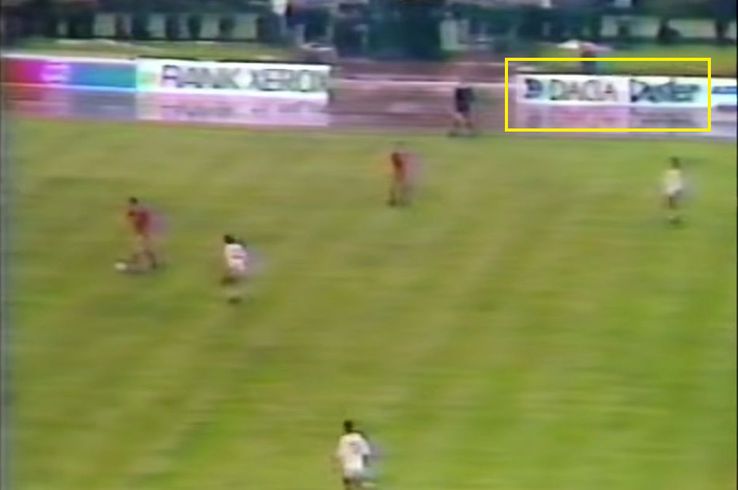
An advertisement for “Dacia Duster” at Dinamo – FC Liverpool, from 1984! It's for good! How was it possible


Article by Octavian Cojocaru – Published on Thursday, 06 November 2025, 13:26 / Updated on Thursday, 06 November 2025 13:46
An advertisement for “Dacia Duster” was placed on the side of the field at a famous match, Dinamo – FC Liverpool, score 1-2, hosted in Bucharest, at the “23 August” stadium, on April 25, 1984, from the second leg of the semifinal of the European Champions Cup. Dacia Duster in 1984? How was it possible, if the model with this name that all of Romania knows today started to be marketed only in 2010? It looks like a mistake, but it's not!
Who is watching the full recording (video HERE with the original commentary by Cornel Pumnea) of the most important match in the history of the Dinamo club they don't have to struggle too much to notice the advertisements placed on two billboards, in close proximity to each of the two reserve banks. On the left was “Dacia Duster”, on the right was “Dacia Duster 4×4”.
In addition to the “nonsense” at Prono Expres, Loz în Plic, Azomureș, Gerovital, Confex, Hotel București, Tarom, since it is an international match, “capitalist” advertisements were also accepted, such as Rank Xerox, Pepsi. But the best placed, the most visible, were those on the “Dacia Duster”.
4the semifinals of the European Champions Cup were played by teams from Romania. Dinamo was the first, in the 1983 – 1984 edition. Steaua checked the next three semi-finals in the 1985 – 1986, 1987-1988 and 1988 – 1989 editions
Dacia Duster from 1984 was, in fact, an ARO!
In 1984, the Romanian state exported a “Dacia Duster” car to the British market, but it was not a product of the Colibași factory, but an all-terrain vehicle, “ARO 10”, made at Câmpulung Muscel.
It was about an all-terrain vehicle that started to be produced by the Romanian car market in 1980, a kind of 4×4 with parts from Dacia. This ARO 10 was inspired by Renault Rodeo and Citroen Mehari.
Dacia Duster from the 80s had modest sales
The first examples were sold on the UK market in 1981 – 1982. In 1982 – 1983, the model was exhibited at several car fairs, including the “London Motorfair”. It was pitched to the British as “the cheapest 4×4 on the market”.
The model was cheap, but there was also a problem related to the impossibility of purchasing spare parts.
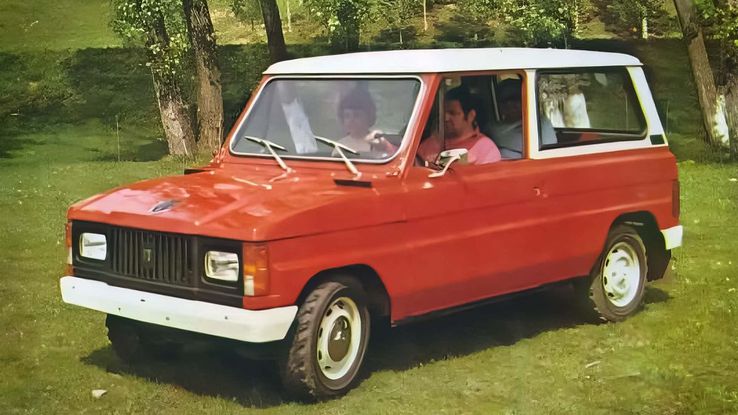
The sales of that “SUV” were below expectations in Great Britain in the period 1984-1986, and from 1987 Great Britain gave up the import of that Romanian vehicle, which could not cope with the competition with Suzuki SJ or Lada Niva.
The Romanian “SUV” was sold under the original name of “ARO 10” also on the markets of France, Italy, Federal Germany, Spain, Greece, Cyprus, but also in African and Middle Eastern countries. It didn't sell well anywhere, and production was discontinued in the late '80s.