Artificial intelligence enters the big central banks, including the NBR. “We have seen many cases of AI being used in fraud,” says a BNR official


From analyzing inflation to detecting banking risks to interpreting the tone of official announcements, machine learning and NLP (natural language processing) algorithms are beginning to change the way monetary policy decisions are made. A Romanian central bank official highlights the dual nature of artificial intelligence in the financial sector
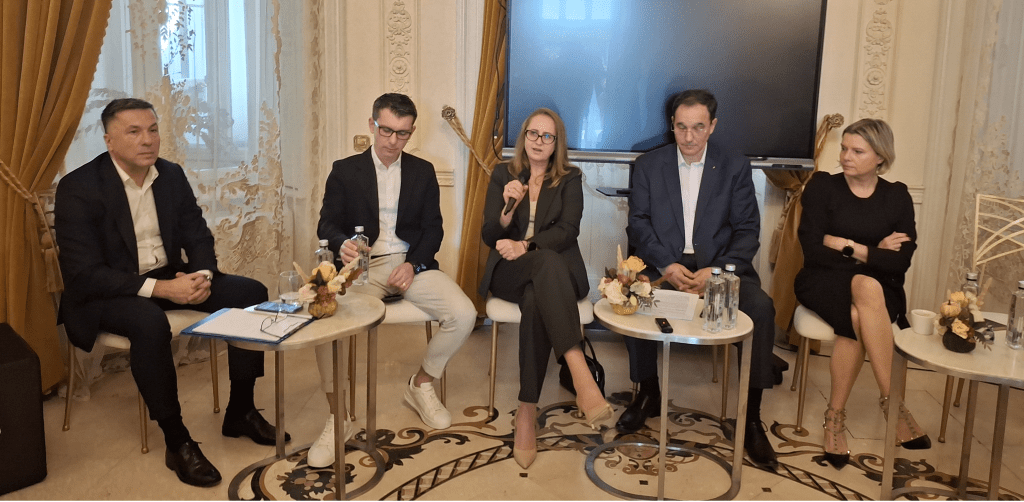
Technology is a double-edged sword that requires careful ethical consideration, according to a senior official of Romania's central bank, present at the conference at the “Real Risks 2025 – Banking & Entrepreneurship in the AI Era” conference organized by Oxygen Events.
Adelina Stoienescu, expert in the Payment Supervision Division at the National Bank of Romania (BNR), said that the institution has witnessed numerous cases in which AI has been used as a weapon for fraud, even if it is becoming indispensable to modern financial operations.
“We've seen quite a few cases of artificial intelligence being used in fraud,” Stoienescu said, citing examples of voice cloning technology that can convince people that their relatives are calling to ask for money. “For us, AI will remain a challenge both from the perspective of the ethics with which it is used and from the perspective of the limitations.”
The statements underscore a growing tension in financial regulation: how to harness the potential of AI while mitigating risks that threaten financial stability and consumer protection.
Adoption in measure
Despite the concerns, the NBR is integrating AI into operations that require repetitive tasks, high-volume data processing and statistical analysis. The institution is exploring the application of AI for security measures and the extraction of essential elements from the documentation of credit institutions, although these initiatives remain in development.
“We are trying to make life easier for you and us, especially the banks, so that we don't have to come back to them all the time with certain requests,” explained Stoienescu.
However, she pointed out clear limits to the application of the technology. “I will never see AI being able to replace areas that involve human interaction,” he said, noting that emotional intelligence and creative activities should remain firmly in the hands of humans.
“There are a lot of things that are made much easier with artificial intelligence. It's true that they also have a much higher degree of accuracy sometimes, but it still comes down to human intervention and the one who creates it and it depends on where it learns. I mean, artificial intelligence is very good if it's built on some sound principles and used in a positive way
I see her helping a psychologist. But I will never see it as a decision-making element in the area of psychology”, says the BNR expert.
Stoienescu cautioned against assuming universal adoption of AI or expecting the technology to solve all problems. She predicted a polarization between those who embrace AI and those who prefer human creativity.
“The person who creates the AI, the person who trains the AI and the person who uses it must use it for positive purposes,” she said, noting that the accuracy of the technology depends entirely on its fundamental principles and training data.
Global trend
The Romanian central bank's approach reflects a broader pattern among the world's main monetary authorities.
The challenge for central banks is to strike a balance: harnessing the analytical power of AI while maintaining the human judgment essential to monetary policy and financial regulation. As these institutions navigate this transformation, their success may depend on maintaining skepticism alongside innovation—recognizing that AI is a powerful tool, but one that requires constant oversight and ethical boundaries.
Central banks use AI models to:
- analysis of texts (reports, news, releases) to measure “economic sentiment”;
- macroeconomic forecasts (inflation, GDP, unemployment) using machine learning algorithms that process many more variables than classical models;
- anomaly detection in statistical data.
The European Central Bank (ECB) uses AI for inflation forecasts and text analysis in its releases and economic press.
The Bank of England has a project called “Nowcasting with AI”, which uses neural networks for real-time forecasts of the British economy.
The National Bank of Sweden (Riksbank) uses AI to analyze real-time payment and transaction data to track economic activity.
The Federal Reserve (US) uses AI algorithms to detect unusual patterns in market data and for stress-testing.
The Monetary Authority of Singapore (MAS) uses deep learning models to detect suspicious transactions in the banking system.
AI engines also analyze how the public perceives central bank decisions, including the tone and impact of communications.
Some banks are testing internal chatbots to help employees or inform the public.
For example, the ECB has an internal system for analyzing the texts of Council members' speeches and the financial press to assess the impact on markets.
Banque de France experiments with generative AI for automatic summaries of economic reports.