Sarmizegetusa Regia, in the age of great discoveries. The still “virgin” capital of the secular forests, guarded by the 107-year-old Romanian


A series of rare images, taken in the 60s, show Sarmizegetusa Regia in one of the most prolific periods of archaeological research, but also of tourism. The travelers who arrived here discovered the temples barely revealed in the middle of the centuries-old forests, but also an archaic world.
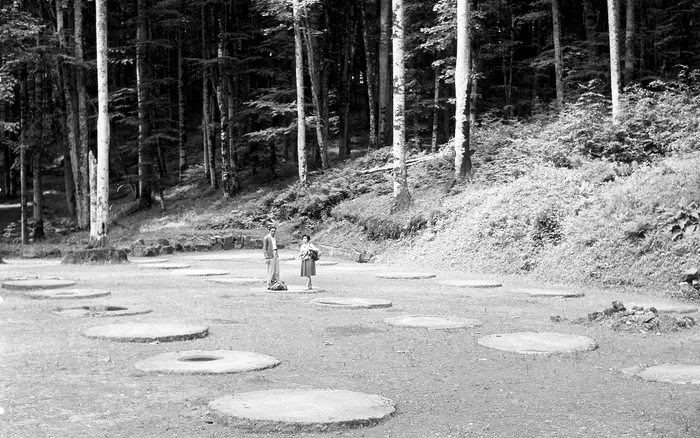
Sarmizegetusa Regia in 1964. Photo Szabó Tamás, Ethnographic Museum of Transylvania.
A series of photographs taken in 1964 by Szabó Tamás and preserved in the collections of the Ethnographic Museum of Transylvania in Cluj-Napoca offer a unique perspective on the Dacian fortress of Sarmizegetusa Regia.
At the beginning of the 60s, the capital of the Dacians was going through the most fertile period of archaeological research. In the 1950s and 1960s, some of its most valuable monuments were completely uncovered: the temples, sanctuaries, the fortification and the paved road. Their appearance was quite unusual, emerging from beneath the waves of earth that had covered them for nearly two millennia.
Patriarch of Sarmizegetusa Regia
For most of the visitors of those years, Sarmizegetusa Regia was an almost virgin territory, hidden on a mountain spur, in the middle of massifs still covered by centuries-old forests. The road from Orăștie to the foot of the Dacian fortress was covered by a forestry train that crossed the Grădiști Valley for almost 40 kilometers, plunging into the wilderness disturbed only by woodcutters.
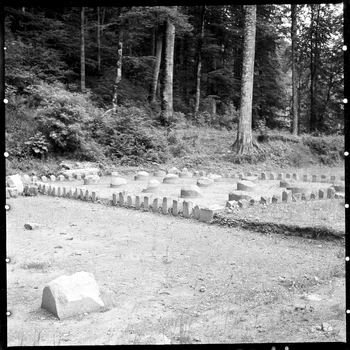
Image 1/10:
Sarmizegetusa Regia 1964 Photo Szabó Tamás, Ethnographic Museum of Transylvania (46) jpg
“Through these surroundings of Decebai's fortress, towering centuries-old trees grew. I found in the bark of a beech encrusted the name of a man who bathed there in the year 1813. In these lands, today, K4 tractors and funiculars carrying logs, transport the huge trees to the slopes from where they are lowered. From the valley, they are loaded into the mountain train and from there taken to city”, A. Păduraru reported then, in a report published in 1955.
Not only the forest that embraced the ruins had a special charm, but also the locals of this patriarchal land. They could be seen roaming the mountain paths on horseback, dressed in the clothing specific to the area, preserving the archaic customs of the mountain villages. Vasile Rujoi, the “guard” of Sarmizegetusa Regia, had already become a legendary figure.
“Many of the students who came from Bucharest to see the ruins of Decebal's fortress met a forester who lives near Grădiştei hill. He is old, he retired a long time ago. He did 25 years of service and retired. There would be many old men in the Orăştie district, but there is none like him. His name is Rujoi Vasile. And he is “significant”. He is 107 years old”, note the same A. Păduraru, in 1955.
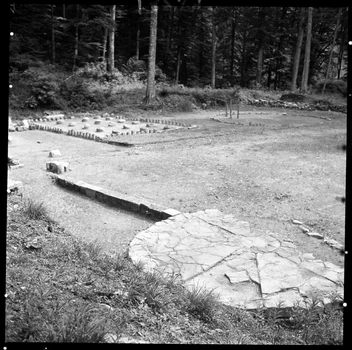
Image 1/10:
Sarmizegetusa Regia 1964 Photo Szabó Tamás, Ethnographic Museum of Transylvania (40) jpg
Vasile Rujoi, the modern “patriarch” of Sarmizegetusa Regia, had lived all his life in the Dacian mountains and worked in the forest. He had white teeth in his mouth and a smile on his face. “This old man is in extraordinary health,” concluded the author of the story.
Sarmizegetusa Regia continued to look like this until the early 1980s, when the extensive restoration project brought it closer to its present appearance.
How Sarmizegetusa Regia was rediscovered
Sarmizegetusa Regia has been known to the locals since the Middle Ages, and the old stories about its treasures also date from the same period. The first extensive research took place here in the period 1803–1804, shortly after the discovery of large ancient gold hoards in the area. Treasure fever had gripped the locals.
“People started a real migration to Grădişte. Every poor man hoped that the fabulous treasures hidden among the ruins would rid him once and for all of his misery and make him rich. The groups heading towards the mountains with axes, hoes, shovels, also attracted the people who were sowing corn from the outskirts of the villages along the way. The work stopped, and every healthy person went to Grădişte”historian Sigismund Jako recorded in 1966.
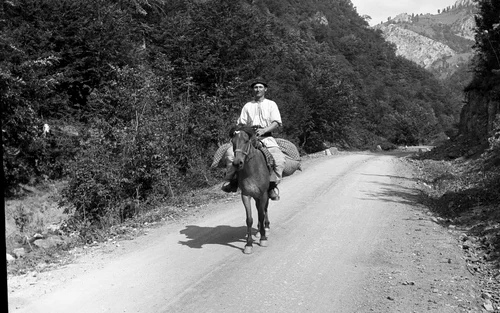
Image 1/10:
Sarmizegetusa Regia 1964 Photo Szabó Tamás, Ethnographic Museum of Transylvania (9) jpg
The Austrian administration in Transylvania sent its representatives to the Orăștiei Mountains to investigate the appearance of some precious treasures in the area. In the meantime, the authorities forbade the local people to dig in the mountains belonging to the treasury, and the area was put under guard at the time, in the hope of recovering the gold from the mountains. However, the locals were not afraid of the imposed measures.
“People left the villages at night, stealthily, and faced the mountains that were sleeping their winter sleep. Neither the autumn rains, the high waters, the impassable roads, nor the sudden cold, nor the dangers of the forests full of beasts could scare the serfs oppressed by poverty, in their rush for luck”. looked Sigismund Jako.
The impressive mobilization of forces in the summer of 1803 did not lead to the discovery of Dacian gold. As a result of these first investigations, the ruins of some temples, the fortification, the pentagonal tower and the Roman bath were revealed, as well as a series of vestiges of historical value, monuments of a “city unknown until then”, as Paul Török, the commissioner of the Chamber Treasury of Transylvania, noted at the time.
Research was resumed in 1804. Then, in the Grădiștea area (the local name of Sarmizegetusa Regia), another hoard of about 987 Koson coins had been discovered. Although the treasure fever had not died down in the villages of the Orăștiei Mountains, the Transylvanian authorities gave up the excavations, leaving them to the locals and antiquities collectors.
“The result of the investigation was that the memorable ruins at Grădiștea Orăștiei were discovered, where the government, eager for cheap profit, made excavations under its own direction, in the summer of 1804, with two thousand soldiers and as many serf peasants. Through these excavations, all the ruins that covered the southern slope of the mountain called Muncelul de la Grădiștea Orăștiei were destroyed, and the result material a was negative, since that crowd of workers could barely find a thousand gold coins”informed the historian Iulian Marțial, in 1923.
The great temples, unveiled in the 1950s and 1960s
In the 19th century, Sarmizegetusa Regia, whose vestiges had remained mostly hidden underground, became increasingly attractive to the scholars of the time and to lovers of ancient treasures.
Systematic research began in the first years after the war, led by the Cluj professor DM Teodorescu. At the urging of the historian Vasile Pârvan, he organized, in the 1920s, the first topographical and archaeological research campaigns in the Orăștiei Mountains. He uncovered part of the ruins of the great sanctuary, but his attention was also directed to the Dacian fortresses of Costești and Blidaru, Fețele Albe and Luncani – Piatra Roșie, as well as to the “Trojan” from Cioclovina-Ponorici.
The archaeologists' plan aimed “thorough research, with a view to future intensive archaeological explorations, of the important and to some extent enigmatic ruins of ancient settlements and fortifications on the mountain tops in the southern part of Hunedoara County”, informs the National Heritage Institute.
Research at Sarmizegetusa Regia continued in the 1930s and 1940s and gained momentum after World War II. In the 1950s, the great circular sanctuary was completely uncovered, but also other sanctuaries, craft workshops and buildings on terraces VIII, X and XI and in the civil settlement. Archaeologists then identified the water adduction and channelization system.
The campaigns of the mid-1950s led to the discovery of the “terrace of painted pots”, where numerous fragments of luxury Dacian painted pottery, glass vessels and iron tools appeared, as well as the famous fragments of the vessel with the inscription “DECEBALUS PER SCORILO”. Also then, the sacred area was also investigated, discovering the quadrilateral sanctuary A, on terrace XI, as well as the ancient paved road leading down to the temples.
At the beginning of the 60s, the Andesite Sun, an emblematic monument of Sarmizegetusa Regia, was completely uncovered, and in the following years, other sanctuaries from the sacred precinct, retaining walls, blacksmith workshops, the fortification and terrace walls, as well as other monuments that can still be admired today, were gradually revealed.
Sarmizegetusa Regia, four decades of transformations
Starting from 1980, Sarmizegetusa Regia entered an extensive transformation process, following a plan that aimed not only to restore and preserve its remains, according to archaeological norms, but also to “beautify” the place, as the Ceaușescu regime wanted.
For nearly two years, restoration teams filled in the famous “andesite sun” with cement, replanted wooden pillars in the Great Solar Sanctuary, replaced weathered limestone blocks with replicas, and brought discs and concrete blocks into the sacred precinct to change its appearance. The defense walls were raised and strengthened, and the authorities of the time even considered moving the original “andesite sun” to the Deva Museum, with a copy to be exhibited at the site.
After the year 2000, archaeologists managed, with great efforts, to return the original plinths to their place. In the summer of 2010, almost 50 concrete discs, “planted” in the site in the early 1980s, were removed, according to a provision of the Ministry of Culture.
In recent years, protection and maintenance work has continued, and recent rehabilitation projects have targeted the Great Circular Sanctuary, the ancient fortification, the Great Andesite Temple and the Ancient Paved Road.