The terrifying weapons used by the most feared warriors of the Pacific. The philosophy of life that turns any injustice into a motive for slaughter

Some of the most warlike populations in history were the Maori, Polynesian tribes that colonized New Zealand. Conflicts between tribes frequently broke out over the concept of “utu” – a form of compensation or reciprocity, which in certain situations also manifested itself through acts of cannibalism.
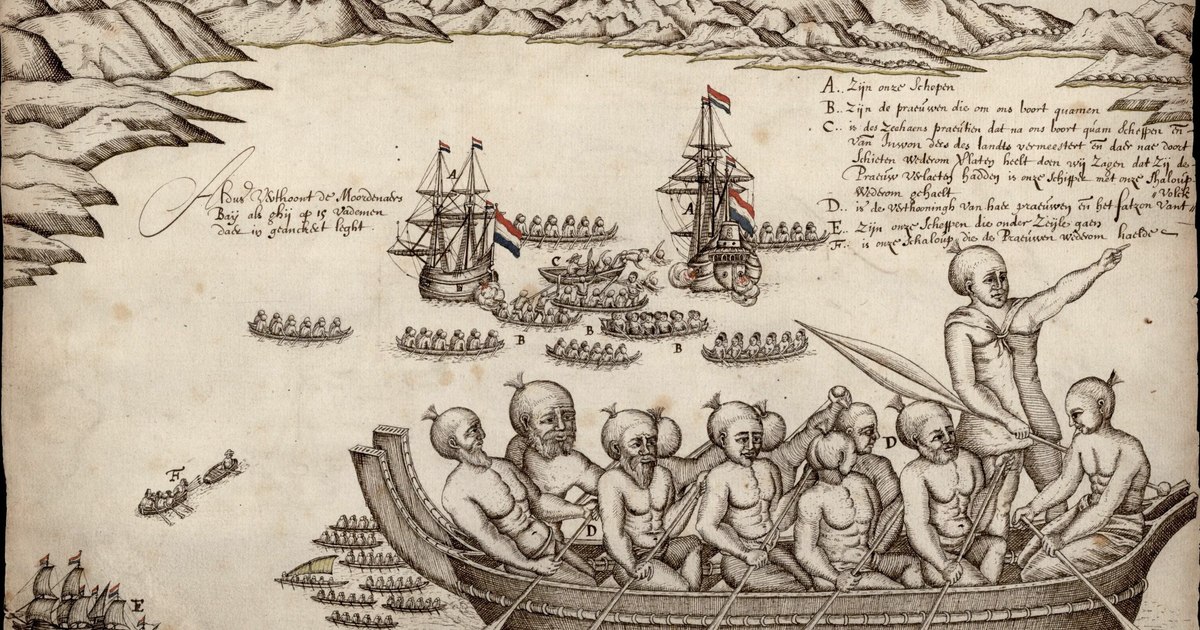
Maori warriors, the first contacts with Europeans PHOTO wikipedia
Throughout history, there have been numerous warrior societies and castes, renowned for their ferocity, military might, cruelty, or efficiency in battle. Among the most famous are the Celts, Vikings, Spartans and Samurai.
A special place is occupied by the Maori tribes in this category of peoples renowned in the world of war. Famous, among other things, for the famous “haka”, but also for their special qualities in rugby, the Maori had a special fame in the past, i.e. a few centuries ago. They were considered fierce warriors, people trained from childhood for battle. And this in the conditions where an important part of their life was governed by a principle called “utu”, which implied “reciprocity”, “balance” through which “mana”, the primordial force of the universe, is preserved by a person. Often this “utu” involved revenge, a fierce fight to punish those who upset the balance and caused a tribe or warrior group to lose that mana, through injustice or insult. This process also involves acts of ritual cannibalism.
The cataclysms that brought the war into the bosom of the Maori peoples
Maori tribes are Polynesian nations. They migrated from eastern Polynesia, an archipelago of over 1000 islands, in the 14th century to New Zealand, Tonga and Samoa. They were tribes of fishermen, gatherers and hunters who most likely left for New Zealand following the overpopulation of the Polynesian islands, where by the 13th century the Tu'i Tonga empire had reached its peak. Actually whole communities, with the help of dugouts, went in search of new territories.
Around 1350 they arrived in New Zealand. The island was divided into zones of influence and distinct tribal territories. To top it off, the Maori tribes of the mid 14th century were very peaceful. They had nothing in common with that culture of war that arose later. It was also understandable. Food was plentiful, the population relatively small and the territory vast. The main prey of the Maori tribes were the moa birds. They were the type of flightless running birds similar to emus or ostriches. Moa birds lived only in New Zealand. But peace lasted only a century in the world of Maori communities here.
About as long as moa birds survived intensive hunting. Since 1450, specialists have noticed an essential change in the way of life of the Maori tribes. Maori fishermen, hunters and herders turned into warriors. Obviously, they did not abandon the traditional activities from which they procured their food, but they ended up creating a fierce warrior culture. Researchers say it all has to do with the changing environment. A volcanic eruption, a tsunami that ravaged the island, but especially the disappearance of moa birds due to excessive hunting, complicated things on the island. Life became harsher and the fight for resources and territory became a way of life, an essential condition of survival.
A life lived in the name of war and the arsenal of death
Conflicts between tribes were quite frequent and the rules of war were relentless. The fights could be fought in the open field, following a predetermined agreement, but often, the opponents attacked by surprise. Either at night when the rivals were sleeping, or during feasts, when they came with hidden thoughts under peaceful intentions. Not to mention ambushes and other surprise attacks. Any form of warfare was permitted and considered honorable as long as the enemy was annihilated.
“Birds can sit and sing in peace, but men will always sleep with fear in their hearts and the fear of the rival's attack”said an old Maori proverb. Precisely to protect themselves from the attacks of their rivals, the Maoris ended up living in real fortresses. These are villages surrounded by defensive ditches and wooden palisades, placed on high promontory, on hilltops or in areas surrounded on three sides by water. Just to avoid surprise attacks. In addition, in order to always be ready for battle, young men were trained from childhood.
They practiced with long sticks but also with rigged weapons. At the same time, they strengthened their physical strength and learned to fight with their bare hands. The ferocity of the battles but also the high frequency of conflicts is also proven by a real arsenal of death used for centuries by Maori warriors. It is primarily about the kotiate, a heavily decorated hard wood mai that acted as a log. It was used to effectively break the bones of the enemy. Once incapacitated, he was killed with a hard blow to the temple area. They also had the wahaika, a single-edged palosh, also made of hard wood, but also the pounamu, a type of mace with a wooden handle and a stone blade at the tip, used to split the opponent's skull. Many warriors primarily used the taiaha, a stone-tipped spear.
Most weapons were used in close combat, hand-to-hand, which required good fighting technique but also impressive physical strength. Many fighters were tattooed from head to toe, including the face. Each tattoo was unique and generally made of spirals. The tattoo was done in a ceremony. It was a very painful procedure, being basically deep incisions in the skin made with a wooden mallet and a chisel.
The color later filtered into these grooves made in the skin was made of fat and ash. The Maori had a strict war calendar. Actually, the confrontations took place only between November and April. The other half of the year was used to gather resources and prepare for a new fighting season. Battles were usually not fought between large armies, but rather between tribal bands. A company, led by a chief, usually recruited from among the most famous fighters, was called a hapu and did not exceed 140 warriors.
A philosophy of life that fueled the fire of war
Maori were also fighting for resources and territory, but mostly because of a principle that somehow maintained this almost uninterrupted cycle of warfare. It was called “utu” and it was a philosophy of life of the Maori people. It is difficult to explain, especially for European populations. It generally refers to “reciprocity” and “balance” and is related to “mana”. For the Maori, “mana” was the supernatural force of the universe that resided within each individual. That mana could be lost if the balance was lost or there was no reciprocity, i.e. that “utu”.
For example, when one tribe wronged another in some respect, either in a commercial transaction or fishing grounds, or simply showed disrespect, then that mana was in danger of being lost, and the “utu” stepped in to restore balance, justice. In most cases the restoration of balance, as a form of restorative justice as Takagi and Shank say, was done through war. It was an unbroken cycle of revenge. The defeated tribe to restore their mana, meaning honor, life force, practiced utu again, on the victors, and so on. The largest battle ever fought in New Zealand was the Battle of Hingakaka in the late 18th century between two Maori armies of the Southern Alliance and those of the Tainui Alliance. Up to 10,000 men, under the leadership of Chief Pikauterangi of Ngāti Toa, fought to restore their honor near Lake Ngarato. It all started from the fact that the fish caught was not distributed correctly. And from there the need to do justice or restore balance.
The cruel fate of enemies
In order to regain the mana lost as a result of injustice, enemies were killed or enslaved. Some were consumed. That is, Maori also practiced ritual cannibalism. “It was certainly there. It is recorded in all sorts of ways in our histories and traditions, many place names refer to it”Professor Margaret Mutu, from Auckland University's Department of Māori Studies, told Stuff.
“I'll kill you and then I'll eat you”say some Maori battle songs. The testimony of a Catholic missionary in Maori territories shows such a practice, described in Maori songs and stories. “You wanted to run, didn't you? But my greenstone club snatched you away! And after that you were cooked and served to my table. And your father, too, was cooked. And your brother? Eaten too! Where is your wife? Look there, I took her for you! Where are your children? Look at them too, carrying me food, hunched over like slaves.”. In addition, Maori are said to have collected the heads of slain enemies.