In the first months after Pandemic, many organizations treated hybrid work as a transitional solution – a compromise until “returning to normality”. In 2022, as much as 63 percent companies encouraged employees to appear more frequently in the office, and only 18 percent. He did not take any action in this direction. Today, the proportions look completely different: 49 percent Organization is still trying to increase office attendance, but already 34 percent. He gives up such initiatives.
Importantly, even the deterioration of the economic situation did not prompt employees to return to offices more frequently.
– We are already waiting for the great return to offices. Today, no one asks if hybrid work will be with us, it is already a foregone conclusion. Another question becomes key: how to manage this model effectively to become real support for business and employees. Organizations gradually give up simple, template solutions regarding the work model and look for a way to adapt hybrid work principles for their goals and needs – says Dorota Osiecka, partner and director of Colliers Define.
In companies that still promote returns to the office, a gradual decrease in resistance from employees is observed – in 2025 this percentage was 85 percent, i.e. by three percentage points. less than a year ago.
The hybrid is evolving
The “Hybrid and Beyond '25” report shows that the number of companies preferring work mainly from the office is systematically decreasing – in 2025 it is only eight percent. Hybrid not only maintains its popularity, but also undergoes evolution. Companies are increasingly moving away from uniform rules for the entire organization, introducing various work models adapted to the specifics of individual teams. This approach is already used by 17 percent. companies, compared to only five percent in 2022 and 15 percent in 2024
– The hybrid work model brings new challenges, but many organizational problems have only visualized. The systematic lack of improvement visible in our research results in some areas of company functioning shows that proper diagnosis and targeted activities are needed. Before we decide to resign from hybrid work, which in most companies has become a standard, it is worth making a real attempt to adapt the organization to effective functioning in hybrid – sums up Dorota Osiecka.
Office market under the influence of hybrid
The dissemination of hybrid work has completely changed the functioning of the office market.
– Companies are increasingly optimizing the occupied area – with renegotiations, reductions reach 20 – 30 percent. in the largest organizations. It is no longer only about savings, but about matching the office to the new rhythm of team work. The elasticity and the possibility of scaling the occupied space, as well as the quality of the work environment, are growing, says Paweł Proński, director of the office space department at Colliers.
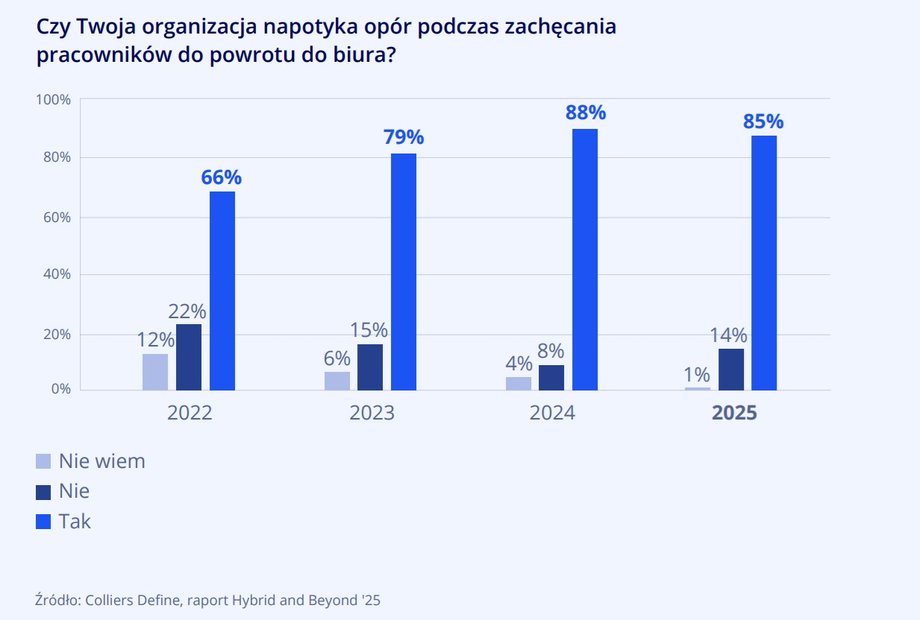
Employees' reluctance to return to the office
|
Colliers
The effect of this transformation is an increase in the number of sublease offers. In Warsaw alone, about 65,000 are available. sq m of office space in this formula – it is about one percent. total modern supply and nearly 10 percent free space. This phenomenon also applies to other cities – including Krakow (19.7 thousand sq m), Łódź (19.7 thousand sq m) and Wrocław (18.5 thousand sq m).
The starting rents remain diverse between regional markets and in Warsaw. In the capital, rates range from 12.5-20 euros per sq m per month outside the center, to even 29 euros in the best central locations. In regional cities, average rents are at the level of 13-19 euros per sq m, with the highest rates to Krakow, and the lowest-Łódź and Katowice.
These differences reflect not only the location, but also the standard, certification and flexibility of the space offered – factors that in the new work model become crucial for the competitiveness of office buildings.
Thank you that you have read our article to the end. Stay up to date! Observe us in Google news.