Cinema glow is an illusion? 13 hours of work, no full -time and uncertain future of filmmakers


Work in the film industry for the average Kowalski seems to be a dream come true. Meanwhile, it is full of contradictions – on the one hand it gives satisfaction with the creation of works viewed by millions of viewers, on the other it is associated with great uncertainty, many hours of photos and a lack of stable contracts. Filmmakers told us about the experience, who not only struggle with demanding work, but also fight to regulate employment conditions and maintain balance between private and professional life.
According to the report “Counted and counting 2024” prepared at the request of the Ministry of Culture and National Heritage, nearly 7,000 work in the film industry in Poland. people. Their life is a continuous sinusoid – for long months without orders, through intensive, exhaustive work on the set, to satisfaction from participating in creating a work viewed by thousands of viewers. And although this industry is associated with splendor and prestige, the everyday life of people working in film productions is full of uncertainty, lack of stabilization and legal gaps that deprive them of the protection of most employees. Filmmakers alert that they act “outside the system”, without the protection of the Labor Code, and many people in the profession struggle with burnout, delays in payments and the problem of maintaining a balance between professional and private life.
Uncertain future and life from month to month
According to Witold Płóciennik, chairman of the Filmmakers' Trade Union, professionally a film operator – the author of photos, they have a very difficult and unique specifics of work, which is little found in other industries.
– Her The main feature is a great uncertainty, especially the future – says Bankier.pl Witold Płóciennik. – Our plans are often limited to the coming months,
We can't think in the future. We would like to work in a mode that would allow you to keep yourself, family or self -development. Meanwhile It happens that nothing happens for half a year, the phone does not rings and almost all of us feel anxiety about what will happen next year or twowhether he will have job offers. This uncertainty is quite difficult, especially nowadays when we see a crisis in the cinema, both in the world and in Poland.
There are no employment contracts here
According to the chairman of the ZZF, all the provisions on working time, hours of resting, or even the rules related to counteracting mobbing, unfortunately apply only to employees. However, almost 100 percent They are not filmmakers.
– Actually, no one is employed under an employment contract And this is probably our trade union challenge. Only co -creators have a contract for a specific work. This is at most 10-15 percent. teams. However, the rest are B2B contracts, because almost everyone has a business. In this case, however, no legal acts say anything about rest and work. This is the legal hole in which we are, i.e. outside the system – explains Witold Płóciennik.
Work 13 hours a day
In his opinion, people from outside the industry do not understand what filmmakers are about.
– We work on average 13 hours, often six or even seven days a week. For many days we sleep in hotels, we do not go in our homes for a long time, because photos take place in various places all over Poland, but also outside our country. This excludes us from a normal family life. That is why we would like these working conditions to be regulated in some way – says the chairman of ZZF.
Work-life balance does not exist?
According to Witold Płóciennik, In the profession of a filmmaker, catching work-life balance is a big challenge.
– Unfortunately, many people are simply burned professionally, because it is difficult to find any stability, private life during production. Working for several months for 13 hours a day, 6 days a week, man is simply completely “washed”. It's very degrading for man. It also causes that Many people leave this industry – believes the chairman of the ZZF.
Overtime and work on Sundays are the norm
The Filmmakers' Trade Union in cooperation with GoodLabs has prepared Study of working conditions. It shows that:
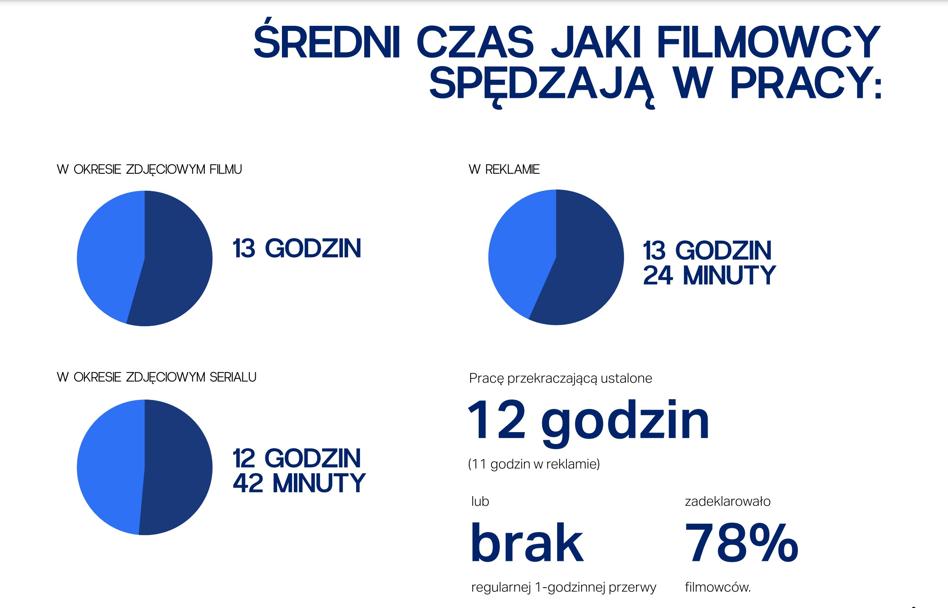
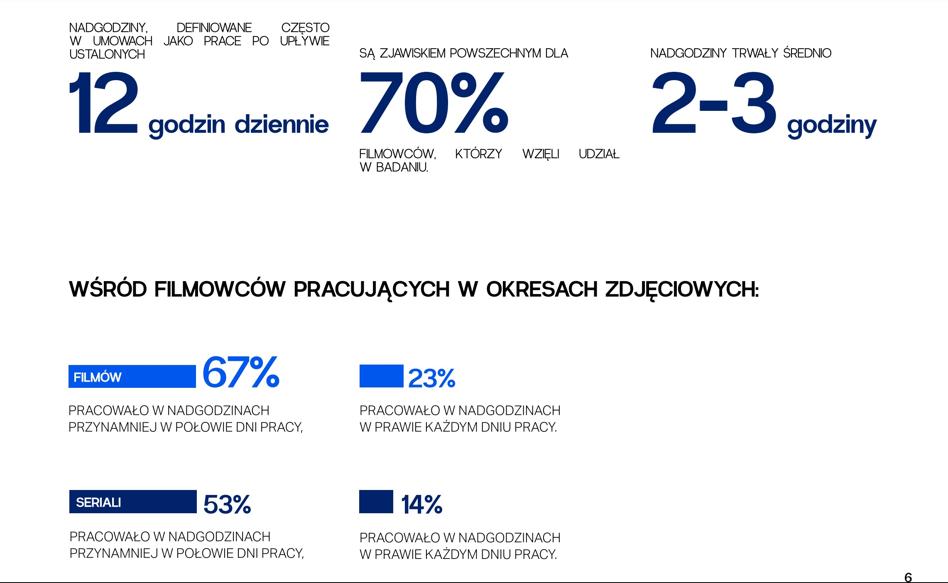
- 69 percent filmmakers work for more than 12 hours a day (on average 2-3 hours),
- On average, they spend 13 hours on the set of the movie, and in the case of the series 12 hours and 42 minutes,
- 21 percent filmmakers worked overtime in most days,
- About 70 percent filmmakers working on films declares a 1-hour break on all work days,
- 27 percent filmmakers happened to have a shorter daily break than 10 hours,
- 20 percent it did not have a single day off during the work week during the film, the film,
- 8 percent it did not have a single day off throughout the entire photo period,
- 89 percent filmmakers worked on Sundays,
- 63.PR. worked on state holidays,
- Only 5 percent Filmmakers definitely agree that their working conditions are satisfying, 26 percent. Rather, it agrees with it, while 12 percent He definitely disagrees with it, and 30 percent Rather, he disagrees.
Important regulations developed
Representatives of the Filmmakers' Trade Union are a great success that on May 6 this year. They signed together with 13 other organizations operating on the Polish audiovisual market, recommending agreement “Principles of working on film and serial productions”, where there is with a maximum of 12 hours of work a day, the possibility of a shortened shooting day, a week of work lasting at most 6 days, 11 hours of break between work days and 35 hours of rest between weeks of work, as well as, with overtime limit.
– Unfortunately, it is known that the word “overall” applies only to employees. However, these are the rules that have never been. Preparing them really lasted 3 years. For now, this is a soft regulation and it is known that it does not always and does not work everywhere, but it is a big step forward. In fact, the biggest challenge is to regulate our working conditions in the film in the form of a legal act. It is not easy, because people from outside our environment often do not understand what we are talking about – explains Witold Płóciennik.
They create works that watch millions
However, with all these minuses, the work of filmmakers can also add wings.
– Most people who work on the film have a sense of co -creating something unusual, telling fascinating stories about our country, humanity, about what is happening in the world right now. This is co -creating a visual work, which is later viewed by thousands, sometimes millions of people – says Witold Płóciennik. – The most interesting is that we are constantly discovering something new, we have new challenges. We rarely return to the same places. In addition The whole team is involved in the creative process, which has a sense of creating something special. In addition, working for so long, we create a film family, which of course is created only during these photos, sometimes longer, but this shows the unique atmosphere of this work. It is a really big positive that makes us pull us to the film, that we love this job. Despite the fact that she is sometimes so ruthless for us – adds the creator.
The actor's work is mainly waiting
According to Klaudia Kąca-Jasic, an actress who played, among others In “Essential Killing”, “AA team”, as well as the series “Agata's Law”, “Deep Water” and “Saint”, working in the film is usually perceived by people as a pleasant and exciting occupation.
– Of course, for the actor, it is often like that, especially when he has a chance to play an interesting character. Work on preparing individual scenes or makeup are also generally a very interesting experience. On the other hand, it is a very physically and tiring occupation. The actor's work is primarily waiting for recording more scenes. Often in low -favorable conditions, e.g. in winter. It is also demanding to go to catings, although today it is a little easier, because you can send a recording online-says Bankier.pl Klaudia Kąca-Jasic. – This profession is also associated with great uncertainty. This is usually not a full -time job, but at most a work contract. Many actors face it. Those who are not employed in the theater cannot count on retirement in the future.
The best earnings in feature films
According to the actress, Roles in feature films are best paid, where rates for one photo day always amount to over 1,000. zloty.
– It is similar in top series. However, much less earns in paradocumers, where actors are often exploited. I used to be PLN 250 for playing the episode-says Klaudia Kąca-Jasic.
In her opinion, a big problem is that Many productions are greatly delayed by the payment of remuneration.
– You usually have to wait for at least a month, but you never really know when the transfer will come. My colleague played in the series, for which the photos took place in June. However, he has not received money for it today – adds the actress.
Independent cinema has no big budgets
According to Radosław Pawełczak, a producer and operator, co -creator of such films as “Kundel”, “Recover himself” or “For the forest”, a slightly different specificity of work concerns independent cinema.
– We treat the films we create a little as a stepping stone. We make them together with a group of filmmakers, primarily for the love of cinema and the need to tell stories. Financial issues are secondary here – says Bankier.pl Radosław Pawełczak. – Of course, it also has its drawbacks. We finance the projects ourselves, so budgets are small, which means fewer shooting days and more intensive workand sometimes also the ability to refine certain details. For this, a huge plus is the atmosphere, because we create a group of friends, and on the set the climate is a bit like in a film family.
As the creator admits, Working on film productions can also be stressful.
– Paradoxically, what I value most in it, i.e. new situations, can also be a source of stress. Sometimes the conditions in which we make a film can be unfavorable. It can be a challenge, but at the same time it gives satisfaction when such a project can be brought to an end – he adds.