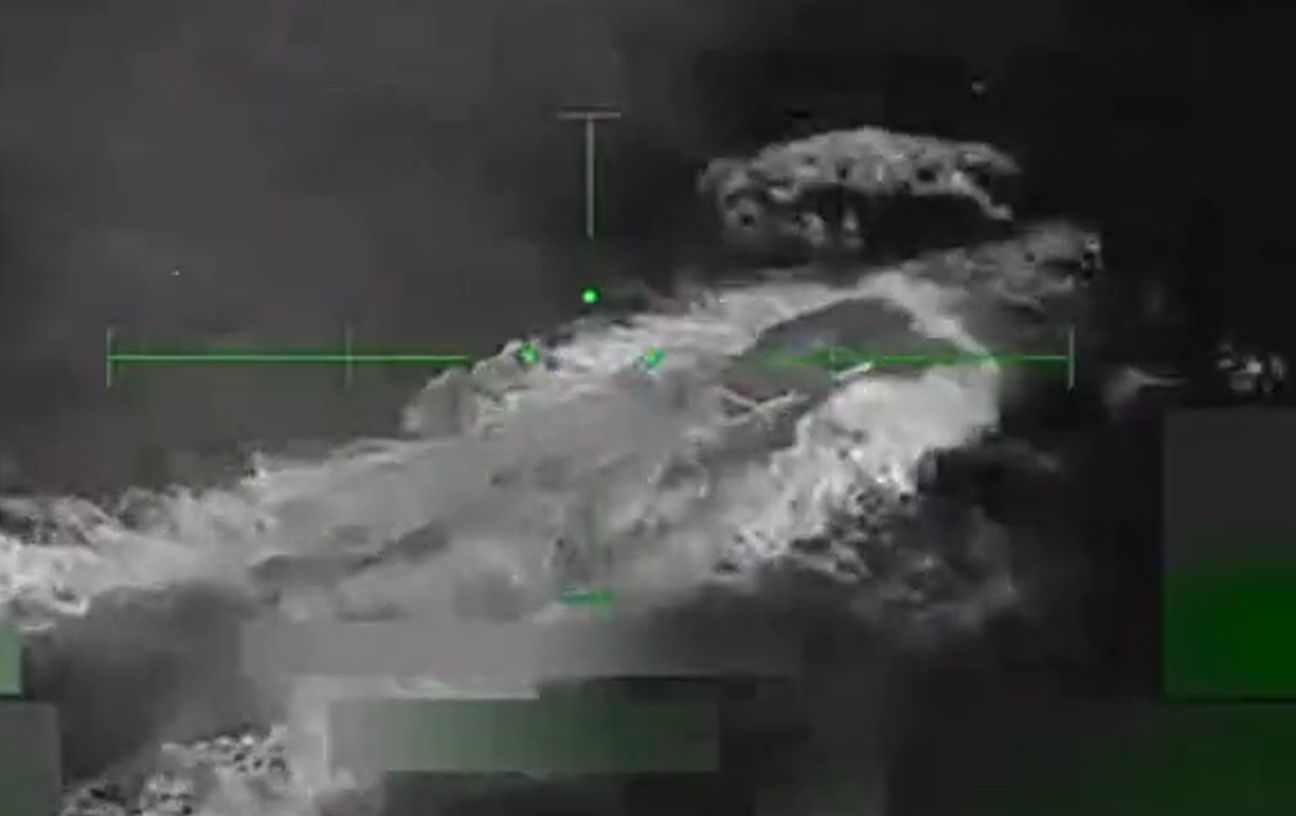
The incursion of Russian drones into Poland has revealed a major Vulnerability of NATO. The Allies recognized it, behind closed doors


NATO officials were worried that Wednesday's response to the incursion of Russian drones into Poland highlighted the lack of preparation of the West in the field of anti-aircraft defense. The Secretary General of the Alliance, Mark Rutte, agrees, writes Politico.
At least 19 cheap Russian drones, made of wood and foam, invaded the air space of Poland this week, being shot down with military systems worth millions of dollars, one that illustrates the lack of proper NATO training for such threats.
But the NATO action was much less effective than Ukraine's typical response. The alliance has shot down about three drones, while Kiev says it usually has an interception rate of 80% to 90% – despite the fact it is facing much larger attacks.
In a discussion with Politico, Ulrike Franke, researchers in the field of policy at the European Foreign Relations Council, observed the existence of a discrepancy between the cheap Russia equipment and NATO's expensive military response.
“What will we do, we will send F-16 and F-35 every time? It's not sustainable. We have to equip ourselves better with anti-drone systems,” he said.
A low cost intrusion
According to Welt, five drones were heading directly to a NATO base before being intercepted by Dutch hunting aircraft Lockheed Mark F-35. It seems that a NATO refueling plane, an Italian supervisory plane and a German Patriot air defense system were involved.
These are equipment worth billions of dollars to counteract Russian gerbera drones, which are imitations of the Iranian shahed model and cost about $ 10,000 each.
But this intrusion with low costs caused a very high reaction.
Poland invoked Article 4 of NATO, which requires the members of the Alliance to meet for urgent discussions. Both Poland and Latvia have closed their eastern airspace, and NATO would be considering “defensive measures”.
A major gap
The anti -aircraft defense has long been identified as one of the main gaps of NATO countries.
The EU also encourages countries to spend some of the SAFE loans worth 150 billion euros for anti -aircraft defense.
But much of this money is destined for very expensive weapons.
Ukrainian President Volodimir Zelenski Himself stressed that MIM-104 Patriot air defense systems and Franco-Italian Samp/T, each costing hundreds of millions of dollars, are not a very suitable option to be used against cheap Kamikaze drones.
Ukraine does not use such equipment to counteract the waves of unanswered air vehicles, which can reach hundreds on any night. Instead, he developed his own very cheap drones to break down Russian threats.
The problem was raised on Thursday, during a meeting between NATO Secretary General, Mark Rutte, and EU ambassadors in Brussels – the first time a chief of the Alliance participated in such a meeting.
Many participants have been worried that Wednesday's response highlighted the lack of preparation of the West.
The NATO army will not be able to use F-35 aircraft regularly to intercept such dangers.
“Rutte himself reached this conclusion and no one contradicted it,” said one of the diplomats.
The challenges of drones
Some of the European defense giants are trying to adapt to the rapid drone armor race.
At the end of August, the Swedish company Saab presented a new cheap rocket, called Nimbrix, designed to neutralize unanswered and low altitude air vehicles.
The French DGA armament procurement agency recently ordered a demonstrator for an anti-drone laser system from a group of companies, including MBDA, Safran, Thales and Cilas.
However, smaller and innovative companies may have difficulty in imposing themselves.
“The startups have made many progress in terms of possibilities. In Europe, I have not necessarily bought (what I sell),” said Franke, from the European Council for External Relations.
There are two main challenges in defense against drones, she added.
The first is that a single system will not be able to reject all the threats: “By definition, we will need a stratified defense, with both electronic and kinetic countermeasures.”
The second is the speed with which the technology evolves: both Ukraine and Russia constantly adapt its offensive and defensive drones in a technological spiral.
This is the approach of Ukraine. It uses electronic countermeasures and produces thousands of interceptor drones per month. Ukraine may face hundreds of drones per night, and defenders destroy the vast majority of them.
For the European armies, this will require a change to the traditional models of expensive weapons in small lots, the former head of the Defense State in France, General Thierry Burkhar, told Polito.
“For certain equipment, it is probably better to buy lots of 10, 15, 20 or maybe 50,” he said.
“It does not matter if the company that develops them is not able to ensure the maintenance for 20 years, because in a year, those equipment will be either destroyed on the battlefield or will be exceeded,” he added.