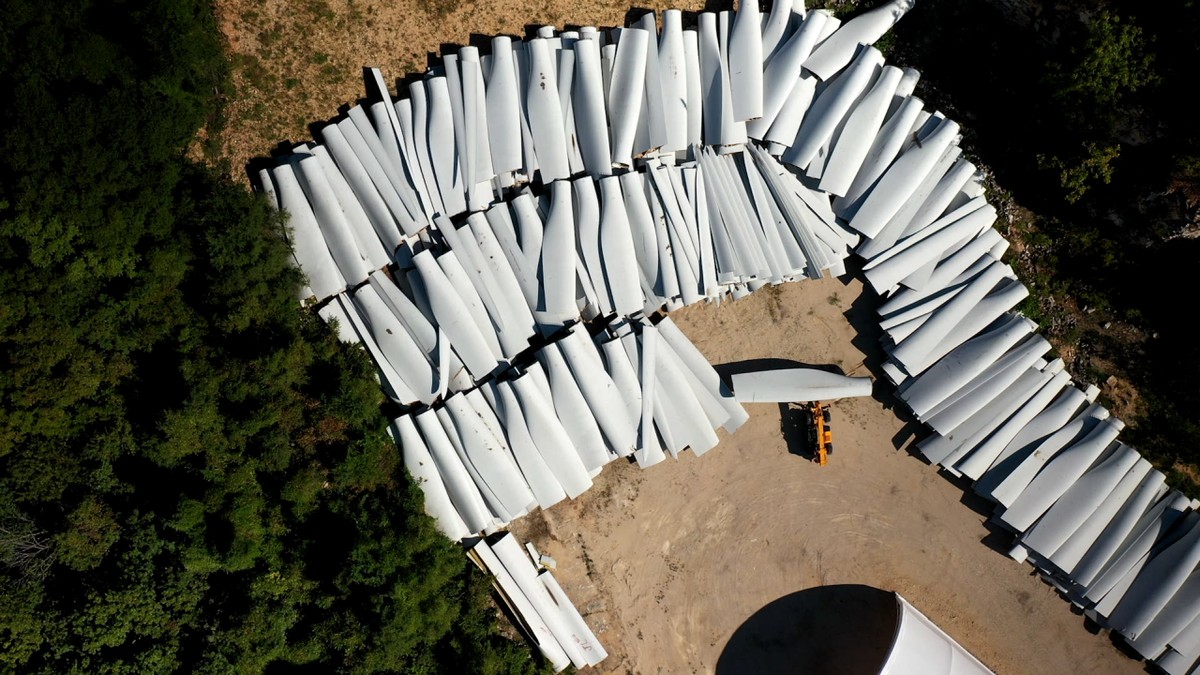
Narrator: Wind turbines are not eternal. Metal towers can normally be recycled, but not a shovel, which is a mixture of fiberglass, wood and plastic.
Until 2050, over 40 million tons of waste from turbine blades can be arrested around the world. Some recycling companies grind blades for a mixture that can be used to produce cement.
The startup with Ohio claims that he has a better way, transforming intact blades into external furniture that will stand in public space.
So what is the best way to deal with this type of waste? And how much rubbish produces wind energy?
With routine maintenance, the wind turbine can survive about 30 years. However, phenomena such as lightning strikes and extreme weather conditions can, however, shorten their service life.
One shovel is equal to the span of the wings of a large commercial jet such as Boeing 747. This is the case with turbine blades placed on land. Sea turbine blades can be twice as long.
Both types are made mainly of fiberglass, which is usually produced by squeezing molten glass through small holes, creating fluffy glass fibers, which can be covered with resin and formed into sheets.
The factories stick the sheets of this material with a special type of resin, which after freezing can never be melted again. This makes conventional recycling, which usually includes melting and transformation, is impossible.
Canvus enters the action. The company receives turbine blades from the entire continental United States. The blades are too large to transport them entirely, so the contractors cut them before shipping.
They come in such a state. The first step is to cut them into even smaller pieces. This rope covered with diamonds grinds and crushes glass fiber instead of sawing it to avoid splinters. One slow, even cut takes about four minutes.
The team calls these pieces fillets, and each of them will become the basis of the final product. You can make quite a lot of fillets from one turbine shovel.
Parker Kowalski, co -founder of Canvus: It all depends on what specific products we process, but usually we get 10 to 45 fillets from one shovel.
Narrator: In the car wash, employees wash fillets to remove dirt and fat that accumulated during use.
Brian Donahue, co -founder of Canvus: Each shovel is mechanically washed in a system that recycled all used water, thanks to which it is not wasted in the process.
Narrator: Some fillets have additional material inside, which employees cut and polish. They distribute the putty to level the surface and smooth all damage caused when the air blades are.
Brian: They can be hit by hail, birds and even lightning.
Narrator: When the fillet is a smooth, empty shell, the band builds a metal frame inside it. These aluminum beams will be the main support for the bench seat. Welders attach them.
The founders of Canvus drew inspiration from pilot projects from around the world.
Parker: We were inspired by bicycle racks and bridges built in Europe. We wanted to develop a series of products that could be created on a large scale.
Narrator: One of the challenges is that each fillet has a completely unique shape.
Brian: They are all different, even if they were in the shovel next to each other.
Narrator: The 2D scanning tool thoroughly outlines the fillets.
Brian: Every small bulge or cavity in the shovel is recorded.
Narrator: Computer -controlled milling machines read the digital outline and cut out a matching piece of wood, which is called the ground. Then the employees glue the ground to the metal frame.
Brian: We use a composite plate, thanks to which the recess does not have to be filled with material at the entire depth.
Narrator: When all the main elements are already in place, you can start painting. Painters make a two -component epoxy resin, mixing the ingredients that together create an extremely durable seal.
Brian: Thanks to this, the product will be easy to maintain. Graffiti will easily leave the product. It will not be easy to outline, so it will look good for a long time.
Narrator: The painted bench is ready to add finishes such as a soft rubber seat. The employee measures and adds granules made of production waste of another company that will become the top layer of the seat. Then he weighs a liquid binder and adds them to the mixture. The team distributes this mixture on the base layer of granules from recycling of old tires and shoes.
None of the craftsmen in Canvus had worked at wind turbines before. These are mainly builders and qualified trading workers.
Joe Cogar, final assembly manager: Take something so big and transform it into a functional work of furniture art? It's amazing.
Narrator: Employees like Joe Cogar are happy that they can give turbine shoves another life.
Joe: Perhaps the shovels “lived” on the farm, doing their work. I think they deserve to continue working.
Narrator: Wind turbine designs change quickly – they become larger and more efficient. However, this means that older wind farms become outdated and turbines must be replaced. This process is called repowering. He can make a huge difference.
The wind farm in Spain replaced 69 aging turbines with only seven new ones. They are much more efficient, thanks to which the farm produces twice as much electricity than before.
Farm operators have a business motivation to modernize their turbines. Of course, this contributes to the growing waste piles.
After assembly, the team prepares their products for delivery. Only one of these benches weighs over 270 kg. The team screws products to the boards, which then fastens on the load box. Five benches, four pots and one picnic set went to the Great Lakes Science Center in Cleveland.
Amanda Taunt, Vice President of the Great Lakes Science Center for Operational Affairs: This is a story about what happens to the things we use, how they are recycled and what is their second life.
Narrator: The center did not pay anything for them. Instead, the sponsors covered the costs that amounted to about 42 thousand. hole.
Parker: The sponsors were local restaurants and bars, law firms, health and fitness centers, as well as several domestic companies.
Narrator: In return, the names of these companies are placed on products next to the QR code, which leads to further information.
Brian: These items have a great history because they are made of withdrawn materials.
Narrator: Customers can also buy goods directly from Canvus. Some products in the scientific center are slightly more decorative than others. They are part of the program called Par, which is an abbreviation of Prime and Ready (prepared).
As part of this program, the band paints furniture only with a layer of white foundation, creating a canvas for artists such as Tessa Lebaron, who receive a salary of $ 1000. for art.
Tessa Lebaron, artist: I am used to painting murals, i.e. flat surfaces, so it is interesting and fun for me to work with something that has curves.
Narrator: For now, Canvus only accepts the shovels of land turbines, not sea, which are much larger. In general, projects like this are not common.
In the United States, the cheapest option is to send fiberglass blades to garbage dumps, which causes some controversy. In 2020, photos of the cemetery of turbine blades in Wyoming spread on the internet, causing an objection.
Meanwhile, in Europe, which has much less garbage dumps than the United States, at least four countries have already banned the turbine blades for garbage dumps, encouraging other options, such as burning them to obtain energy or chemical recycling.
Within nine months of production, Canvus has placed over 1000 its products throughout the United States. The undertaking is not quite profitable yet.
Brian: This year we earned eight dollars. 2023 will not be profitable for our startup, but we see a light future in front of us.
Narrator: Until now, the company has changed the purpose of about 250 shovels, but the founders estimate that in 2024 they will reach 3000. Not all blades will, however, be upcycling.
Brian: Some blades are too damaged to be transformed into our products.
Narrator: The founders say that in 2024, about half of the blades they receive will be upcycling and the other half will be crushed. This technique was tested in the US during the recycling of the shoulder.
Veolia Miele blades with a soft mix that looks like a mulch. It pays cement plants for burning this material as fuel instead of coal.
The main goal is to keep the blades away from the garbage dumps, but Veolia estimates that it can also reduce by about 25 percent. carbon dioxide emissions resulting during cement production.
Brian: We will also be able to grind this material, i.e. production scrap and damaged shovels, and send them to the cement plant as Veolia does.
Narrator: Brian hopes that over time a larger percentage of shovels will be able to recycled, and it is best for innovations to be created.
Brian: Some are working on a process called a pyrolysis, which, hopefully, will be able to break the material back on oil and glass fiber.
Narrator: Experts say that fiberglass blades will continue to be used in the near future.
Claire Barlow, Wind Turbine Researcher, University of Cambridge: The problem with the use of metals is that they are heavy. Glass fiber gives us the same strength and properties, but with much lower weight.
Narrator: It is also quite cheap. It is difficult to find a replacement that would match all these features. However, many people work on the issue of waste from the shoulder, including a company that completely changes the way of thinking about turbines.
Airloom builds wind farms that look completely different – there are no giant blades on them. The company claims that their construction costs about a quarter of what the construction of a typical wind farm.
If such a solution were adopted, it could be a problem for the Canvus business model, but the founders are convinced that they will not run out of material.
Parker: Over the next 10-15 years, we will have tens of thousands of blades that will need to be recycled or upcycling, which is why we support solutions such as Airloom.
Narrator: So if wind energy generates so many waste, should the world use it to a lesser extent?
Well, basically every form of energy leaves waste, including combustion of fossil fuels, which produces billions of tons of warming the planet of carbon dioxide each year.
Solar panels are difficult to recycled electronic waste, coal burning produces toxic ash, and oil refining leaves sediment and so on.
One study estimates that there may be 400,000 soon. tons of waste from shovels, which will grow with each year. However, if you combine it with other types of energy waste, turbine blades are almost at the very end.
For a perspective, we will add that garbage from households from around the world exceed them all.
Brian: Let's hope that every step forward will bring much more pluses than minuses, but the minuses will always be. There will always be people who will emphasize the disadvantages of a project.
Narrator: Experts also claim that there is room for optimism, even in the case of hard -to -manage fiberglass waste.
Claire: If enough money is allocated for given problems, you can usually solve it. This is currently happening and good solutions appear.
Crowd: Piotr Nazek