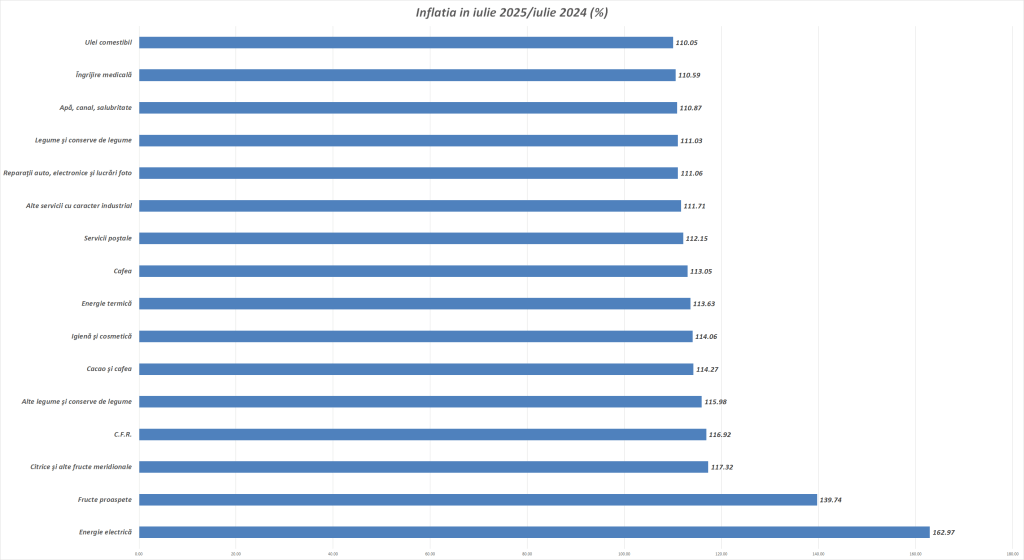
Inflation (calculated on the basis of CPI) ascended from 5.8% in June to 7.8% in July, after energy and fruit prices exploded. Today, the BNR governor will hold a press conference on the inflation report and it is almost certain that it will change the BNR inflation target for this year. Romania has been in front of the most inflation of European states for several months.
“We estimate that inflation will enter the range 7%-8% in quarter 3 of 2025, with an increased probability to reach the upper limit of the interval at the end of the quarter. Subsequently, in the 4th quarter, in an optimistic scenario, the inflation will be stabilized in the mentioned interval. year, ”said a report of BRD published a month ago
Other banks are even more pessimistic and see inflation rates of 9 or even 10%.
Even the central bank speaks of an increase in inflation with a “broad jump in the third quarter 2025, under the transient impact of the expiration of the scheme of capping the electricity and increase from August 1 of VAT quotas and excise duties.”
Prior to the BNR decision to maintain the key interest rates on Friday, ING sent to the investors: “The meeting (the BNR BNR board) is significant because it precedes the publication of the inflation report, which will reflect the impact of recent tax measures. The report (to be published on Monday- no) emphasized in 2026. It will also provide information about the bank's opinions on economic growth and the effects of fiscal policy ”.
“The inflation of June has already surprised in the upward sense, and the inflation at the end of the year is 7.9%, with a peak of over 8.0% in September-October,” says ING.
In the quarters and the following years we will have to get used to inflation fluctuations, a BRD report shows. And this for at least 4 reasons. Of course, we can also discuss how today's statistics correspond to the new technological and digital realities.
1.
Romania loses every 10 years one million inhabitants due to emigration and negative natural increase. And this will have a negative impact on productivity. It remains to be seen to what extent the adoption and integration will be able to act as a stabilizing lever, notes the authors of the document.
The aging of the population can lead to changes in consumption models, the older individuals usually spending different from the cohorts made up of young people. This change can influence the demand in the economy, further complicating inflationary tendencies. The implications of these demographic changes are deep. Governments face the difficulty of addressing the tax tasks of a population that ages but at the same time to encourage economic growth.
2.
The risk of loss of crops in different regions is increasing either due to drought or floods, and this leads not infrequently to increase food prices. The prevalence of pests and diseases will increase, because warmer temperatures create favorable conditions for their spread, endangering even more harvests.
The direct consequence of reducing agricultural productivity is an increase in food prices. As the crops decrease due to climatic unpredictability, food supply decreases, which leads to higher costs for consumers. This inflationary pressure can be exacerbated by interruptions in the distribution of foods caused by extreme meteorological phenomena, wars or pirate attacks, which forces ships to find longer and more expensive routes.
Food inflation can have wider economic implications, especially for those who spend a significant part of the income for food.
In addition, as food prices increase, central banks may face pressure to adjust monetary policy, further complicating inflation management.
3. The widening of the gap between resources and fiscal needs
As governments try to reduce the resource gap through loans, they can contribute to inflationary pressures. The increase of government expenses, especially if it is financed by debt, can lead to a higher demand in the economy. If this demand exceeds the offer, it can lead to increased prices, especially in fiscal policies, such as consumer homes and goods.
The fiscal problem is an inflation source and if the deficit increases, inflationary pressure also increases, says the BNR governor, Mugur Isarescu.
Moreover, when governments allocate a significant part of their budgets for debt service, they can eliminate expenses for public services and essential investments. This wrong allocation can stifle economic growth and exacerbates inflation by limiting the productive capacity of the economy. For example, if the funds that could have been used for the development of the medical sector are directed to debt reimbursement, the economy may have difficulty increasing, which leads to higher prices, because the offer does not cope with the demand.
4. The potential use of the price of raw materials as a “constraint tool” within geopolitical stresses.
The use of prices of raw materials as a tool of constraint within geopolitical stresses significantly influences inflation and economic stability.
Geopolitical tensions, such as Russia's invasion in Ukraine, increase the prices of raw materials. This situation appears because both countries are key exporters of essential goods, including energy, cereals and fertilizers.
The interruption of these deliveries has led to the increase of prices and complications on the markets of other raw materials.
Countries can use prices of raw materials as a coercive instrument in international relations. By controlling the offer or establishing the price of critical resources, nations can exert pressure on each other in order to achieve their political goals.
For example, energy exporting countries can handle oil prices to influence the economies of importing nations, thus affecting their political decisions.
Recent volatility of energy prices has shown how geopolitical considerations can lead to significant economic repercussions, including inflation increases and supply chain interruptions.
The increase in prices of raw materials directly translates into increased production costs for enterprises. As companies are facing higher expenses for essential inputs, they often transfer these costs to consumers, which leads to higher retail prices and inflation. The European Central Bank has noticed that geopolitical risks can increase inflation and reduce industrial production, further complicating economic conditions.
Geopolitical stresses also create uncertainty in supply chains, causing companies to look for alternative sources of raw materials. This change can increase costs as companies sail in new relationships with suppliers and, potentially, higher rates or transport expenses. The need to diversify supply chains in response to geopolitical risks has become a priority for many companies, contributing even more to inflationary pressures as they adapt to these changing conditions.