Israel announces that it has parachuted humanitarian aid in the Gaza Strip. “It's a grotesque distraction”, warns the leaders of humanitarian organizations

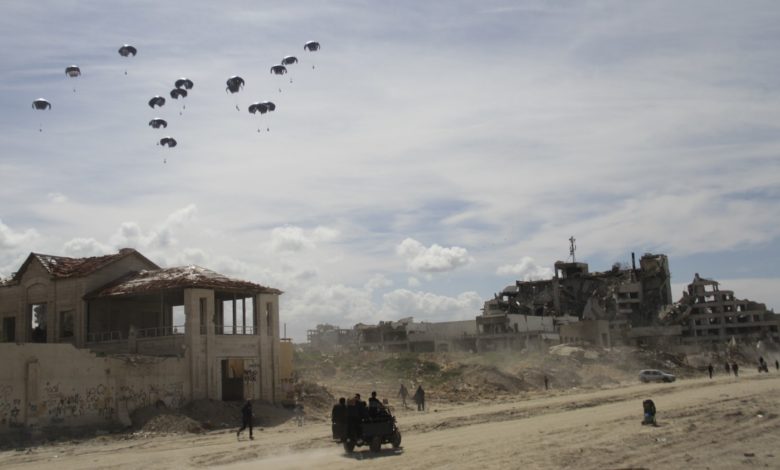
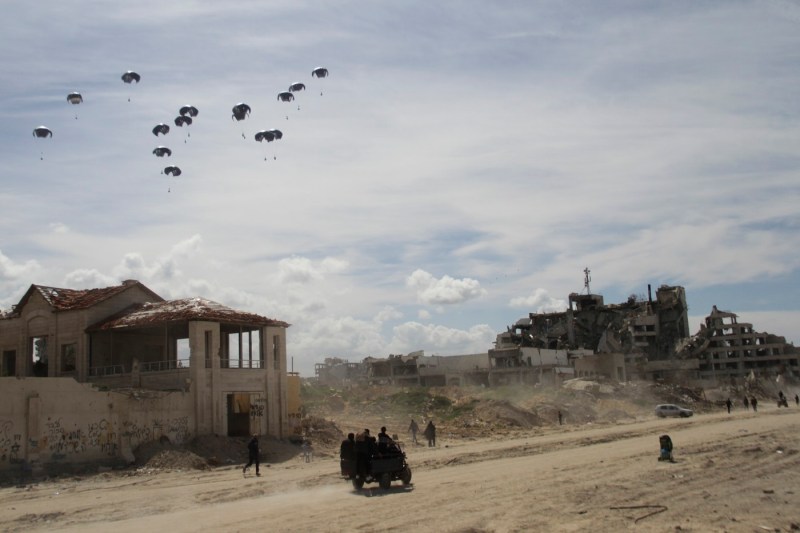
Photo with illustrative character – parachuted aids in Gaza. Credit Line: Mahmoud Essa / AP / Profimedia
After several weeks of pressure and international criticism, Israel announced on Sunday morning that he has parachuted humanitarian aid in the Gaza Strip. But this will not reverse the more serious food crisis in the enclave, they warned the leaders of humanitarian organizations, according to BBC and News.ro.
The day before the aid was parachuted, on Saturday, the Palestinian civil defense announced that 40 people died from the bombing and Israeli firms. Then, during the night, the Israeli authorities announced “a humanitarian break” in the civilian centers and corridors to allow the distribution of humanitarian aid, accusing the UN for blocking.
On Sunday, the Israeli army announced that the parachute of aid in Gaza, which consisted of “seven lots of aid containing flour, sugar and can,” was coordinated with international organizations and conducted by Cogat, an agency of the Ministry of Defense in Israel.
The help of Israel comes after weeks of international pressure to allow food and other vital products to reach the hungry population in the Palestinian territory devastated for almost a month of war.
Ciarán Donnelly, from the International Salvation Committee, said that the airline deliveries “can never ensure the volume or quality” to the necessary aid.
The attention paid to the air deliveries in Gaza is a “grotesque distraction” that will not reverse the more serious food crisis in the territory, the leaders of the humanitarian aid agencies also warned.
An analysis by the BBC found that about 160 planes would be needed to provide sufficient food for a single meal for each of the two million gases.
Terrestrial humanitarian transport would be easier, faster
Over 100 international organizations of humanitarian aid and groups for human rights have warned of an increase in infantile malnutrition and the risk of a generalized hunger among the population in the Gaza strip.
The Ministry of Health of Gaza, led by Hamas, reported on Saturday another five deaths caused by malnutrition, bringing the total number to 127 from the beginning of the war. From this issue, 85 are children. According to the World Food Program program, one in three inhabitants of Gaza does not eat for days, and 90,000 women and children need an urgent treatment.
The warnings regarding the emergency for humanitarian aid to reach the Gaza and the impossibility of transporting them on traditional terrestrial routes, have lit a debate on air supplies.
The head of the UN Agency for Palestinian refugees, UNWA, Philippe Lazzarini, said on Saturday that aid aid throws are “expensive, inefficient and can even kill informed civilians” if not done correctly.
Lazzarini said that his organization has “the equivalent of 6,000 trucks” in Jordan and Egypt, waiting for “green wave” to enter Gaza. He said that the political will is necessary to “raise the siege, open the gates and guarantee the safe displacement and the worthy access of the people in need.”
“The transport of humanitarian aid by car is much easier, more efficient, faster, cheaper and safer. It is more worthy for the population in Gaza,” Lazzarini wrote.
His comments were made before Israel announced that he would determine what he called “designated humanitarian corridors to allow the Safe movement of the UN convoys and drugs.” He did not specify where they will be and how they will work.
Israel argues that there are no restrictions on the help that arrive in Gaza, a government spokesman beforehand that the UN collaborates with Hamas to disturb the distribution of the aid. The UN rejects this statement and argues that Israel prevents its ability to collect aid in Gaza through bureaucratic obstacles.