Commercial agreement between the EU and the US, after months of tense discussions. The announcement made by Ursula von der Leyen and Donald Trump


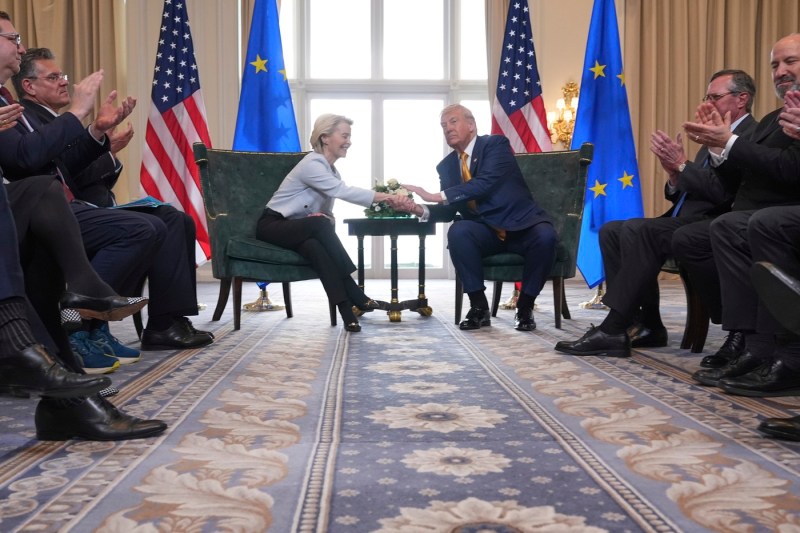
Donald Trump and Ursula von der Leyen discussed in Turnberry, Scotland, Sunday, July 27, 2025. Credit: Jacquelyn Martin / AP / Profimedia
The European Union and the United States have agreed on a commercial agreement that sets a 15% customs duty for most goods, including cars, announced US President Donald Trump, at least for the time to tense negotiations, The New York Times reports.
Based on the agreement, the EU will invest massively in American energy, also buying US military equipment, Donald Trump said.
The understanding will “rebalance, but will allow trade on both sides,” said the President of the European Commission, Ursula von der Leyen, while making the announcement with Donald Trump.
“I succeeded,” the US president said.
Although the agreement seems to be a preliminary one, which leaves many open questions, it could bring some calm for one of the most important economic relations on the planet and could alleviate the fears about escalating the commercial war. Last year, the European Union represented almost $ 610 billion out of the $ 3,300 billion in goods imported by the US.
A greater fee than the EU hopes
The customs duty is higher than the 10% that Europeans were waiting for and Donald Trump has set for British goods. On the other hand, the level of 15% reflects the main tariff in the US and Japan agreement, announced last Tuesday, and is less than 19% and 20% imposed on several Southeast Asia countries.
The agreement comes after weeks of unpredictable discussions. A month ago, Europeans believed that they were close to an agreement, but on July 11, the US president sent them a letter that threatened them with a rate of 30% if an agreement was not reached until August 1.
Even after the announcement, the President of the European Commission stressed that it is important to continue the discussions and the attempt to be perfected a negotiated solution. The EU also continued to take steps to develop a reprisal plan against American tariffs, which can be implemented quickly if needed. The potential countermeasures were completed last week.
Taxes in the car and Pharma sector, two central points
Reducing tariffs for European car exports was an important point for Europeans, especially for Germany, the largest economy in the EU. The European car producers, who sent cars worth 38.5 billion euros in the US, had to suffer because of 27.5% customs tariffs imposed by Trump in April.
The pharmaceutical rates represented another major problem in negotiations. The Trump administration threatened last month that it could increase customs duties for pharmaceuticals – the main export product of Europe to the US – to 200%. Such a high level would have been crushing for the industry. Governments did not clarify when it will happen with the rates on pharmaceuticals.
On Sunday, before the discussion with Ursula von der Leyen, Donald Trump said that pharmaceutical products “are very special” and should be manufactured in the US, even if he acknowledged that the US will probably import “a lot” of medicines in Europe.