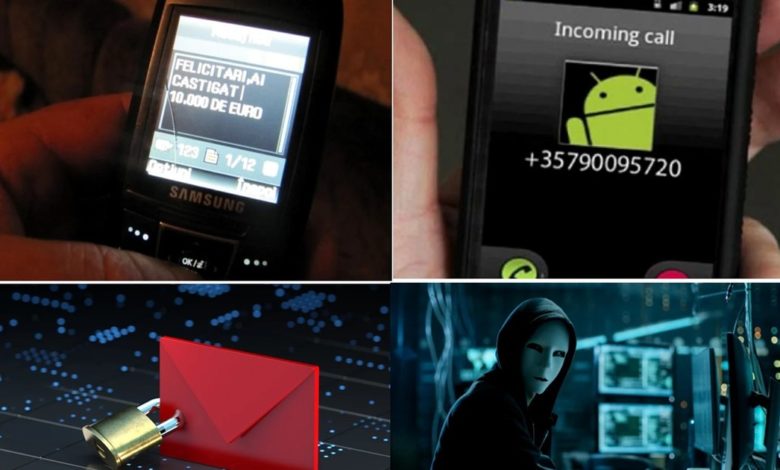
Online frauds caused losses of 1.03 trillion dollars last year and only 4% of the victims managed to recover their lost money, while only 28% of the victims reported frauds to the authorities, a study shows.
Online frauds caused losses of 1.03 trillion dollars last year. Photo archive
Moreover, at the level of the Computer Crime Fighting Section (SCCI) at the IGPR level, in the first 4 months of this year there were a number of 928 computer fraud files, of which 170 had been registered in 2025.
Of these, 169 have already been resolved, announced Flavius Nistor, head of the Directorate for Combating Organized Crime, IGPR. Regarding the computer attacks, at the SCCI level in the first 4 months there were a number of 1,187 files, of which 256 were resolved. At the same time, Flavius Nistor added that the investment frauds reached the first place at European level.
The most popular fraud scenarios currently
One of the most common fraud scenarios uses the spoofing method. The victim is called by the “bank” or another institution, using a false phone number, and is asked to verify that it is called from the bank by searching the respective phone number.
After the victim performs the verification and sees the number on the official site, he is confident that he talks to a representative of the institution.
Then, the attacker asks the victim to transfer the money he has available in a secure account, as his bank account has been compromised, to be protected. The victim does not know that once the money is transferred, he can no longer recover them. Following the pressure of the attackers, invoking an emergency sense, takes the operation and transfers the amount to the account indicated by the attacker. However, this account is under the control of the attackers, being an account of money. As soon as the amounts enter the beneficiary's account, they are withdrawn by the criminal group or further transferred to other accounts.
In other cases, the attacker tells the victim that he has approved his credit and that he is waiting in the branch to pick up the money. The victim is scared because he did not ask for any credit and wants to solve the problem as soon as possible, so he tells the attacker that it is a mistake because he has not made any credit request. Then, the attacker confirms that his data were compromised and that this case will be reported to the police, so in a few minutes it will be contacted by an officer. A few seconds, she is called from a phone number by a person who is recommended to be a police commissioner and communicates that she has been the victim of a fraud and need to provide support to the police to complete this case and to catch the fraudsters.
The “home” work can turn you into money cart
• False offers of employment on social media through which the victim reaches Telegram groups, getting to use his own bank account for requested transactions.
• Danger: The victim can become part of a money laundering network.
• Don't give Like & Share for money.
Fraud “Are you in this video”?
• A message that has circulated very frequently on instant media and social media networks, which asked the victim if it is in the video sent.
• The victim clicks on the clip and gets to install a malware and lose control over the account.
• Another type of popular message requires voting certain people to win a competition or scholarship.
Crypto platforms and fake wallets
• Different influences or public persons who promote unknown platforms are used, but they have links with illegal activities.
• Investment platforms never transmit links for investment, on any communication channel, never offer investment tips and do not request personal or wallet data.
Emotion makes us less vigilant
Regardless of the exposed story, the first time fraudsters will try to excite us to be more impulsive and less vigilant.
“Offenders in the online environment are constantly improving their methods and scenarios, which is why it would be important not to block ourselves in technical analyzes of photo, video or audio elements that accompany the fraud attempt, as to be aware of three elements that are common in most fraud. Regardless of the story of the attackers, the first time will try to excite us to be more impulsive and less vigilant. The emotion can be positive (“you have won a prize” or “you win ten times the amount invested in a month through our program”) or negative (“The bank suspects a fraud on your account”, “someone has made a loan on your behalf”). Subsequently, we will obsess in the scenario presented the second element – the emergency (“now validates the data or you lose access to the account”, “there are x places available”). Finally, the third element is also a clear indication that it is an attempt to fraud – the request to provide data, to install applications on the device or to open certain accounts. If you find all these elements in a call, message or mail received from a stranger, from a friend or even from a certain entity in the public or private sector, you are most likely very close to falling into the trap. Stop and report the initiative to the authorities!” – Mihai Rotariu, coordinator of the Communication, Marketing and Media Directorate of the National Cyber Security Directorate (DNSC).