The world changes their masters: the new geography of wealth and surprises, as they appear in a report of the largest Swiss bank



Profits, money, entrepreneurs. Credit: Anna Omelchenko / Panthermedia / Profimedia
Eastern Europe and the United States lead the growth of global wealth, while powers such as Western Europe and Latin America are in decline, a new UBS report shows, which reveals dynamic changes in the wealth and no.
Eastern Europe: The unexpected champion
With an annual growth of over 12% of total private assets, Eastern Europe is passed in the UBS ratio as the fastest under -growing sub -region, surpassing North America.
Croatia, Poland and Hungary are registering two -digit growth of medium and median wealth per adult in real terms.
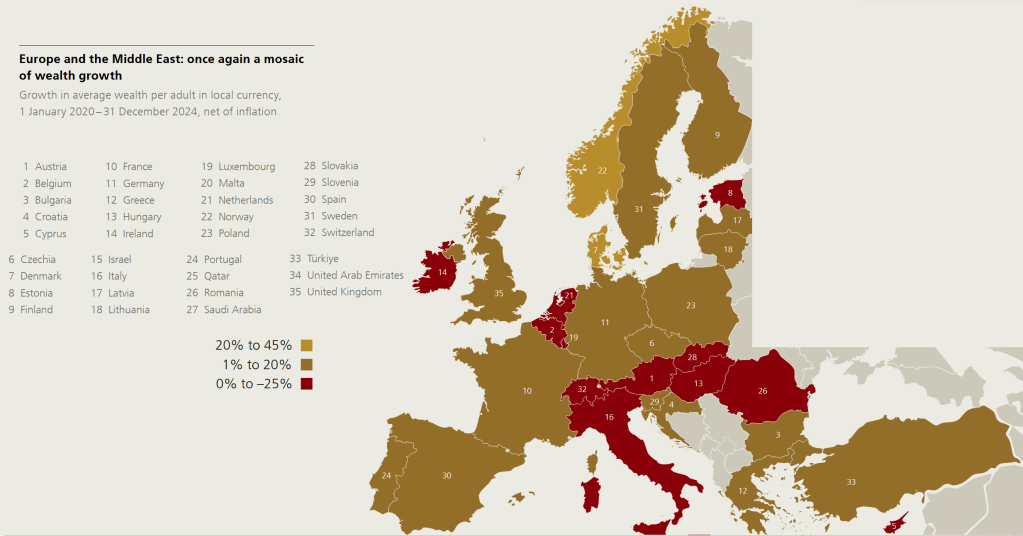
Although they start from a lower base than the West, these countries have a systematic improvement in their indicators, which translates to a significant increase in the number of millionaires.
Performance of south of Europe and Israel
Greece is approaching 80,000 inhabitants, with a net wealth of over $ 1 million, on an upward trajectory. Spain records over 1.2 million millionaires, while Portugal reaches 175,000. An extremely large percentage of millionaires in Israel.
However, UBS emphasizes that the trajectory is not homogeneous. In Spain, wealth increases mainly through investments. In Greece, the impulse is attributed to the rebirth of the real estate market and the recreation of economic trust. In Portugal, the wealth transfer to younger generations is limited.
The two superpowers and those who lose ground
The United States and China still hold most of the global wealth, with a share exceeding 54% of the total distribution. Only the US has almost 35% of global richness, due to the stability of the dollar and the growth of financial markets in 2024.
China maintains a weight high mainly due to the size of the population, but with an accentuated slowdown to the previous years. The UBS records that the rate of wealth growth in continental China (China, Hong Kong, Taiwan) has been at 3.4%, following other regions.
Western Europe, Oceania and Latin America are the three regions that will record a decrease in wealth in 2024, after adjusting according to the size of the population. UBS points out that the distribution of worldwide wealth changes not only geographically, but also socially: the middle classes of the past now accumulate capital, while traditional centers lose their relative domination.
Power in ascension
In addition to the geographical changes, the UBS also records a spectacular change in the social structure of the wealth: the number of “daily millionaires” Emillis – people with assets between $ 1 and 5 million – has been quadruple since 2000 and now rises to 52 million worldwide.
They hold $ 107 trillion together, an amount almost equivalent to that of ultra-rich, and represent the “spine” of the new class of investors that-according to the UBS-shapes consumption trends, wealth transfers and investment strategies.
UBS ends with a finding that is found in the whole report: the wealth increases globally, but not everywhere and not for everyone. The geography of the wealth changes dynamically, with the emergence of new centers, the withdrawal of the old ones, and the “middle peak” takes on a key role.