Fitting against Trump at the G7 summit? “We've already seen how it ended”

Still, the other leaders [poza USA z Kanady, Wielkiej Brytanii, Włoch, Francji, Niemiec i Japonii] They will want to lead him to focus on other urgent issues, such as joint prevention of military threat on the part of Russia.
– They will want to talk about [cłach]but Trump will want to talk about counteracting China, “said Josh Leipzig, senior director at the renowned Washington Think Tank Atlantic Council. – The question that they ask for will be: “How can you ask us to create a alliance against China, since at the same time we try to alleviate the effects of customs?” He added.
According to Atlantic Council, other economies must face an effective customs rate of 12 to 16 percent, the highest since the great crisis in the 1930s.
While Great Britain has concluded a temporary trade agreement with Trump, three other G7 member states – Germany, France and Italy – are still on the fire line as EU members, which operates as a common commercial block. Japan, another club member, is located in the upper part of the scale due to the high share of cars in exports to the USA.
Dutch may increase on July 9, which makes the peak the last real chance to conclude an agreement at the highest level, face to face.
– G7 is a practical and important natural final date, which largely depends on the US flexibility regarding the reaction to the customs, taking into account all other conversations – said the Canadian diplomat who wanted to maintain anonymity.
Music for the ears of Ursula von der leyen
When the leaders gather on Monday in the luxurious mountain resort Kananaskis, the first of four sessions will be devoted to these commercial issues.
Prime Minister of Canada Mark Carney will open the first session on the global economy, world trade and a world -based order (formerly) based on principles.
It will be music for the ears of Ursula von der Leyen, which heads the European Commission and manages the Union's commercial policy. The EU is also represented by Antonio Costa, chairman of the EU Council, thanks to which the number of world leaders will increase to nine.
In March, Trump started an customs offensive, applying 25 % Dutch on steel, aluminum and cars, and in April introduced the so -called mutual duties in the amount of 10 percent For Great Britain, EU and Japan.
If you fail to conclude a transatlantic trade agreement, the EU rate is to increase to 50 percent. From July 9 – although several court cases in the USA and comments of the Secretary of Treasury Scott Bessent suggest that this deadline may change. Trump has already doubled duties on steel and aluminum to 50 percent, threatened to apply fees on medicines, and his government is working on subsequent tariffs on semiconductors, copper and wood.
However, no one at the negotiating table will want to antagonize Trump. The EU behaves rather calmly – he refrains with the proposal of a retaliation package worth over EUR 100 billion [427 mld 730 mln zł] on American goods and so far he has not been pressing to launch sanctions.
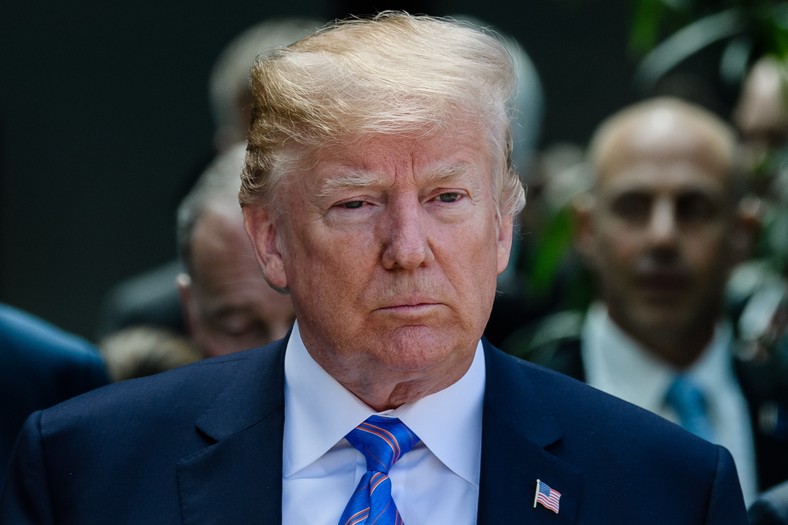
United States President Donald Trump after leaving the G7 summit in Charlevoix in Canada, June 9, 2018.
Diplomatic miracle
Changing Trump's position on customs, however, seems practically impossible, especially now that the actual income began to flow into the American treasury. So why try at all? The peak in Canada will therefore not bring – unless there is a diplomatic miracle – a customary joint statement. Instead, at least seven separate texts will be created on such a variety of topics as key raw materials, artificial intelligence and forest fires.
G7 should remain a team, said the German government official. – our host, Canada, thinks the same. Also for this reason, we will not have a common statement on all topics, but rather separate documents – added the clerk. – Also Japan, Canada and EU countries have different points of view among themselves – he said, hinting that there is no unity between the members of the peak in all matters.
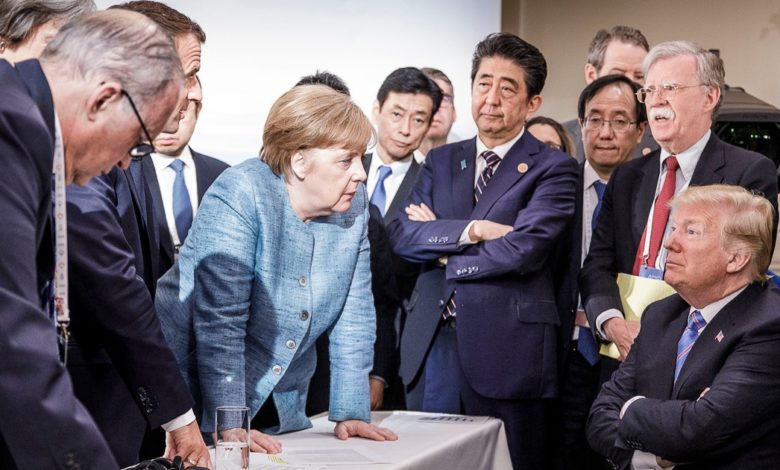
The host, Canada, perfectly remembers that the G6 style approach does not work – the iconic photo from the summit in 2018 shows Trump surrounded by other leaders sitting with arms folded. Above him, the then German Chancellor Angela Merkel, who rests his hands on the table, and her expression on her face reveals irritation.
“In the case of G6, if there were a collusion, I think it would have the opposite effect,” Leipzsky said. “We survived it during the G7 summit in Canada in 2018. We saw exactly what it looked like, and it didn't help anyone,” he said.
But most importantly: – This will only cause further divisions and this is not in the interest of any country in an average – or long -term perspective – said Leipzsky.
Storm
The tense and fragile G7 meeting in 2025 is simply part of the survival of a tanker caused by Trump. The other six countries and the EU need the help of the United States in counteracting imperialist Russia and stopping assertive China.
In particular, for Brussels and London, the G7 format served as an effective forum to agree on a joint strategy of sanctions against Russia for its war with Ukraine. This week, von der Leyen organized an unusual press conference to announce further EU proposals regarding sanctions for petroleum products made from Russian oil and a reduction in the global oil price limit from 60 to 45 dollars. [222 do 166 zł].
On Tuesday, the President of Ukraine Wołodymyr Zelnski, who still has fresh painful memories of the sharp reprimand of Trump in the oval office, will also take part in the G7 peak. Zelnski told Politico that he regrets this row, but he did not give up.
In 2022, after Russia began a full invasion of Ukraine, the G7 agreed to limit the price that the Kremlin can get as oil exports, which effectively stifled its income from the export of this raw material. The United Kingdom imposed restrictions on maritime insurance, and the EU on fleets and ports, while the United States was a pillar of pressure through financial institutions and access to dollars trade.
Since the agreement on this matter is unlikely, leaders will rather wonder how to continue to implement smaller contracts. For example, China's restrictions on the export of key raw materials have an impact on everyone. Even the so -called partner countries, which also participate in the peak – Ukraine, Brazil, Mexico, South Africa, India, Saudi Arabia and the United Arab Emirates – will probably want to sign this initiative.
“The best scenario in my opinion,” Leipzsky said, “there is a lack of serious conflicts.” He also pointed to the acquisition of the G7 leadership by the President of France Emmanuel Macron. As the most experienced leader in this group, Macron will want to ensure its survival of the next year of customs and war.