Donald Trump's obsession turns the world upside down. The professor explains where she came from. “She rooted in it for a long time before he became president”

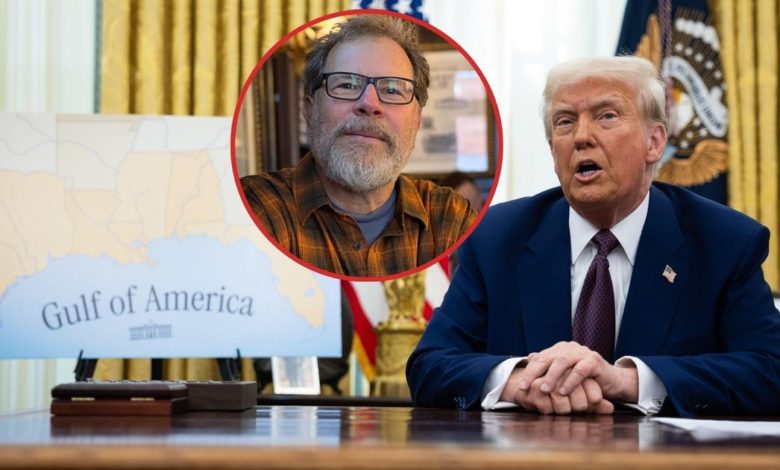
Trump's claims to the territories and changes in their names have real geopolitical consequences, both in Canada, Panama and Greenland. Now the mania of the US president is expanding to the Middle East. In the face of escalation, tension with Iran Trump is considering changing the name of the Persian Gulf to “Arab Bay”.
According to experts, Trump's cartographic obsession and his desire to change the map rooted in it long before taking the office of the president.
The tense exchange of sentences between President Donald Trump and Prime Minister of Canada Marek Carney about making Canada 51. This week, the US state is a lively example of how the president's direct demands regarding the change of world map shaping and complicate his foreign policy.
Trump's grievances caused anxiety among allies and fears that the enemies would feel embarrassed to make territorial claims – not to mention the huge confusion.
According to Karl Offena, a professor of geography at the University of Syracuse, the political tactic of the current US president is deeply associated with his experience in business and brand building. Trump gained influence on the purchase of real estate and brand rights.
“Maps and politics are connected from the very beginning,” says offen.
“I am a developer of real estate deep in my heart,” Trump said on Tuesday, May 6 during a meeting with Carney in the oval office, referring to his desire to subordinate Canada to the United States.
“When you get rid of this artificially drawn line, you'll see a beautiful landscape without it,” he said.
In 2022, Trump told journalists Peter Baker and Susan Glasser: “I love maps. I always said:» Look at the size [Grenlandii]. It is huge. It should be part of the United States “”.
Mexico President Claudia Sheinbaum threatened to sue Google for permission to change the name “American Bay”.
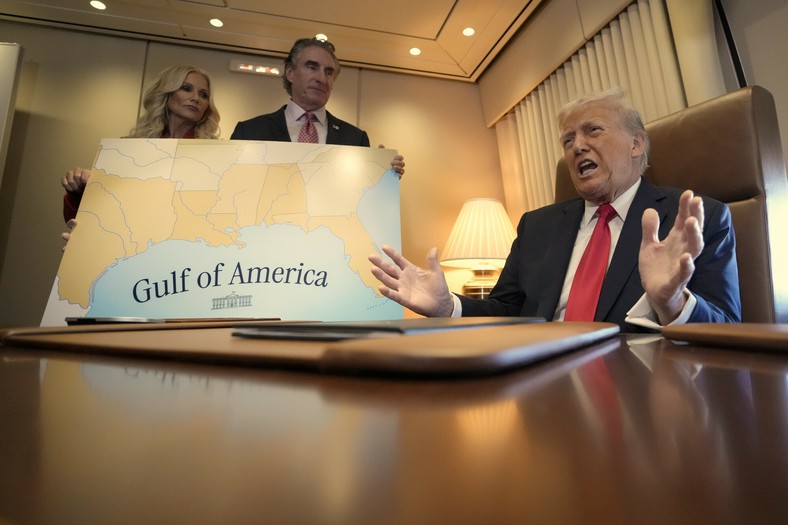
President Donald Trump at Air Force One while announced on February 9 a day of the Gulf
The Minister of Foreign Affairs Iran promised “the anger of all Iranians” if Trump introduces the name “Arab Bay”.
“There are places that will never be for sale”
Maps have been a key element of Trump's political communication for years. During both of his non -designer term of office, he resisted on the election maps of individual counties, which cover the country with red color [barwa Republikanów]to strengthen the legitimacy of their victories – despite the fact that these maps do not show that the red counties are usually less populated than blue (in 2016 he lost in a universal vote).
Since winning the second term of office, Trump has published several political maps in social media, including those that show the “American Bay” and the United States connected to Canada. As his expansionist impulses became more and more bold, he began to present them in terms of real estate.
For example, Trump called the Gaza Zone, destroyed for 18 months of war, “real estate on the ocean” and “large building plot”, and on Instagram he released the film “Trump Gaza” generated by the artificial intelligence. He presents a vision straight from the developer's dreams.
When on Tuesday, May 6, Trump invited the Prime Minister of Canada Marek Carney to the oval office, his comments on “51 state” were the most important topic for the newly selected prime minister.
“As you know from the real estate industry, there are places that will never be for sale,” Carney said, sending a message to his countrymen.
Trump replied: “Never say never.”
“We will never, ever be a property”
Trump complained that Canada “robs” the United States economically and argued that both countries would be in a better situation if Canada proceeded to the Union. He and Vice President JD Vance said that the United States has interests in the sphere of security related to Greenland, citing threats from Russia and China. The United States also has wider strategic interests in the raw material of the Arctic region, where melting ice opens new trade routes.
However, the fascination with the President with Canada and Greenland can be partially explained by their size on the map. Canada is the second largest country in the world, and Greenland is the largest island.
– However, their northern latitudes also mean that the commonly used Mercator projection increases their size – says Ryan Weichelt, head of the Department of Geography and Anthropology at the University of Wisconsin at Eau Claire.
– If you want to achieve something, you make it look big. It has long been a common tactic in political cartography – an appropriate projection is used to emphasize your point of view – adds Weichelt.
In a statement for Politico, the Director of White House Communication Steven Cheung praised Trump for “a deep understanding of geography and history”, adding that “this administration is based on American uniqueness.”
The visit of the second Lady of Usha Vance in the capital of Greenland, where she was to take part in the dog sled race in March, was suddenly dismissed after the Danish and Greenland officials condemned this journey as an escalation of Trump's rhetoric regarding annexation.
“We will never, ever we will be owned that you can buy, and I think this is the most important message that should be understood,” said the Prime Minister of Greenland Jens-Frederik Nielsen last month, announcing Carney's answer.
The change of the Mexican Gulf into the “American Gulf” also caused chaos among journalists accredited in the White House. Officials blocked reporters and photographers Associated Press access to some events in retaliation for naming guidelines contained in the stylistic guide, which recommends using the original name, and not the term used by Trump.
The judge finally ruled that the information agency must be restored to the group of journalists accredited in the White House.
During the talks on the nuclear program, he told Iran Trump on Wednesday, May 7 that he would “make a decision” regarding the change of the name of the Persian Gulf to the “Arab Bay” during the next week's trip to Saudi Arabia, Qatar and the United Arab Emirates.
– I don't want to offend anyone. I don't know if anyone will feel offended – said the president.
Iran reacted quickly. Seyed Abbas Araghchi, the Minister of Foreign Affairs of this country, said that the change of name would be a “short -sighted step” and “only the anger of all Iranians”.