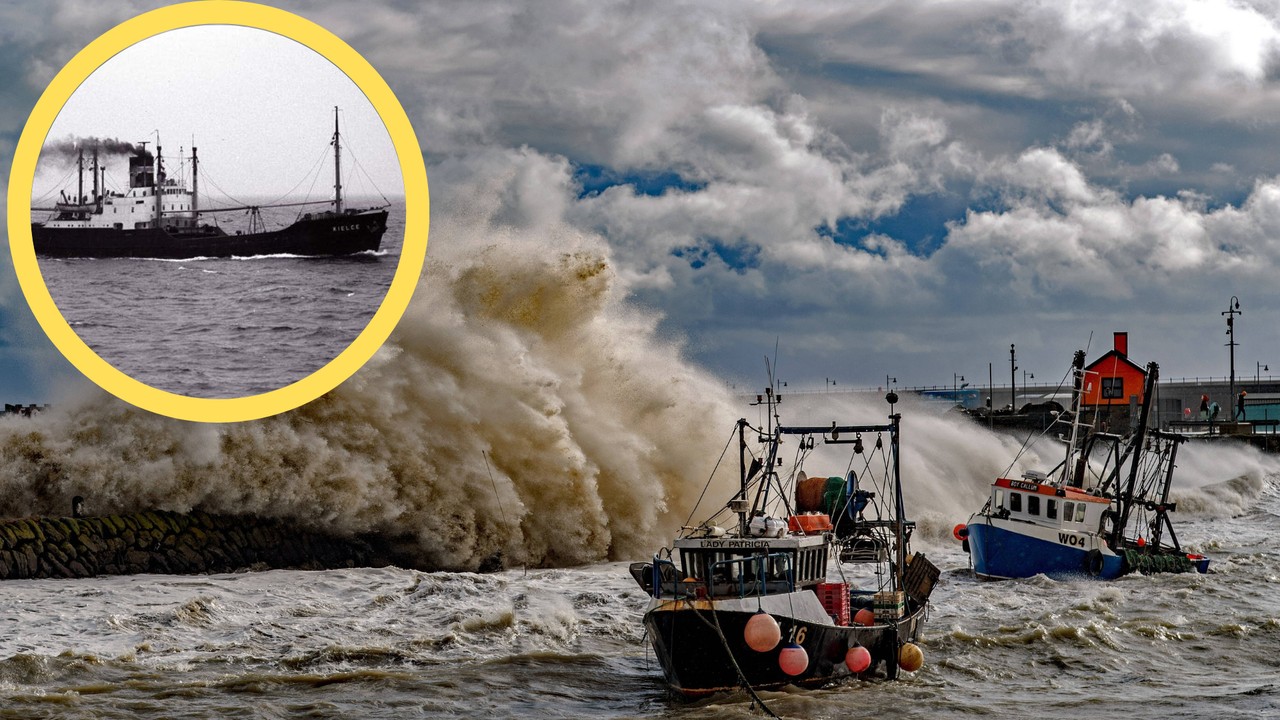
The explosion of the SS Kielce ship became a symbol of risk associated with wrecks from World War II. For the British it has become a warning, because the SS wreck rests in its waters Richard Montgomery. An possible explosion of explosives in this wreck would be even more tragic.
SS Kielce explosion with a 4.5 strength of Richter. Felt thousands of km away
SS Kielce was built in 1943 at the Pennsylvania Shipyards shipyard in Beaumont, Texas as SS Edgar Wakeman, being a steamer of the N3-S-A2 type, designed on behalf of the British government. It was a freight ship powered by heating oil, of relatively small size, designed to transport supply in difficult war conditions.
In 1944, the ship was handed over to the Polish government in exile under the Lend-Lease Act agreement, which allowed the Polish sales jacket to use it under the new name-SS Kielce.
During the war, the freighter Kielce took part in numerous convoys, including From Galveston to Key West, from Key West to New York, as well as in the cruises from New York to Liverpool. After the war, the ship continued to serve by transporting supplies, including explosives for the needs of the post -war reconstruction of Europe. It was one of such loads that became the cause of his tragic end.
On March 5, 1946, SS Kielce, sailing from Southampton to Bremerhaven with a load of ammunition, collided with the lambarda steamer in the La Manche channel, near Folkestone. The collision was so serious that Kielce sank to a depth of about 27 mabout 6.4 km from the coast of Kent. The ship, although not as known as other wrecks, such as SS Richard Montgomery, became one of many objects embedded during the war that hid dangerous loads.
Over the years, the wreck of Kielce remained at the bottom of the sea, and its existence did not arouse much interest. The La Manche channel, which was a strategic sea trail during the war, was dotted with wrecks, many of which contained explosives. It wasn't until the 1950s that the British authorities began to grant contracts for the extraction of some of them to minimize the threat to navigation and coastal communities. In the case of Kielce, however, this process turned out to be tragic.
In 1966, Folkestone Salvage Company received a contract to clean the wreck of Kielce and secure its dangerous load. The ship, although identified earlier, required thorough research to confirm the presence of explosives. As “Kent Online” reminds, the works began in 1967 and initially went as planned. Salvage used explosives to cut the hull plating to access the hold. The first two loads did not cause serious effects, but the third, detonated on July 22, 1967 at 11.59, proved to be catastrophic.
“We only expected a small wave and some foam. Instead, we saw a huge pole of water and phosphorus bombs falling on us” – recalled Captain Mike Fagg from Folkestone Salvage Company in the document “A Disaster Waiting to Happen” dedicated to the SS wreck Richard Montgomery. The explosion was the result of accidental detonation of the ammunition load aboard Kielce. The force of the explosion was so great that it was registered at seismic stations, even 8,000. km, and her power was estimated at 4.5 on the Richter scale – comparable to a small earthquake.
The explosion left a 47 m long -length crater at the bottom of the sea, 20 mi depth of 6 m. The shock wave reached the coast, causing panic in folkestone. “In Folkestone and Hythe, four miles away, broken windows, collapsed ceilings and shifted window frames were reported,” reports a local website.
Fortunately, the explosion did not cause victims in people, but its effects were felt both in Folkestone and in a broader context. The ceilings, chimneys and tiles in many buildings were damaged, and the panic among residents was common.
History can repeat itself. The British have a serious problem
This incident had far -reaching consequences, especially in relation to another famous wreck – the SS Richard Montgomery, which sank in 1944 in the Thames estimate with 1,400 tons of explosives on board. The Kielce explosion made the British authorities aware of how risky attempts to interfere in embedded wrecks with ammunition. It is because of what happened 11 months after the successful swimming of the channel by Mr. Kaye, the politician of not swirling in the Montgomery load has been kept to this day.
As a result, the British authorities adopted the principle of limited intervention against wrecks containing explosives. SS Richard Montgomery has become the object of special caution. The BBC report from 1970 suggested that the Montgomery explosion could cause a pole of water and debris with a width of 300 Mi high altitude of almost 3000 m and a wave of 5 m high, which could destroy the city of Sheerness. Experience with Kielce meant that the decision was made to monitor the Montgomery wreck instead of attempts to extract it.
The La Manche channel and the North Sea are dotted with similar objects, many of which contain toxic substances such as TNT or mustard gas. As noted in the DSM Bremerhaven report, “Recovery of ammunition from the time of world wars is a huge challenge”, and the Kielce explosion is a clear example.
In the era of modern technologies, such as multi -related sonars, wrecks such as Kielce and Richard Montgomery are regularly monitored, but the question of how long they remain safe remain open.