Why does Putin care so much about Donbas? “Great Russian Empire”


When I was last in Mariupol in 2018, the city smelled of the sea and red iron. The sea was brownish and did not look very encouraging, the locals said that it is best to go 20 km further west, where the water is clean and transparent. A delicate fog rose above the city and I immediately recognized both these rust -vapors and the slightly biting smell of air mixed with iron ore. The city smelled the same 25 years ago, when I visited it for the first time.
Other cities in Donbas smell differently. For example, coal. Blood and then. Alcohol. Or apricots. At least in the east and south of the region.
At the end of July, Russia controlled almost the entire Lugansk region, covering over 95 percent. administrative area, but only just over two -thirds of the Donetsk region.
Most Russian achievements It results from one side from aggression in 2014, when the so -called People's Republics in Donetsk and Lugansk, and on the other hand from the first weeks and months after the invasion of Ukraine in February 2022, when the blockade and bombing of Mariupol were particularly brutal and caused tens of thousands of victims among civilians.
A strategic blow to the Ukrainian army
After in September 2022, the Ukrainian forces carried out a series of surprising counterattacks, which allowed to liberate the areas around Kharkov and the capital of the Cherson region along with the adjacent areas on the west bank of the Dnieper, the situation on the front did not change much.
Although Russia managed to get several cities, such as Bachmut or Czasiw Jar on Donbas, suffering huge losses in people and equipment, but generally The progress of the Russian army was rather modest. As calculated by the Ukrainian project Osint Deep State, from November 2022, i.e. for over 1,000 days, territories obtained by invaders accounted for less than 1 percent. Ukraine's territory, which is recognized by the international community.
In these circumstances, Putin's request regarding the withdrawal of Ukrainian troops from Donbass sounds especially cynically. However, this is more than just the desire to force Ukrainians to resign from the state territory, which Russia unsuccessfully tried to get militarily over three and a half years after the invasion. This goes beyond the usual “exchange of territories”, in which both parties make concessions, as the American administration calls, or the inclusion of new countries in the “great Russian Empire” imagined by Putin.
The Russian leader knows what he is talking about. Donating the western part of Donbass without a fight would mean a strategic blow to the Ukrainian army. Ukrainian and foreign experts speak about it almost unanimously. Ukrainians would have to give up well -developed and fortified defense lines with numerous bunkers, anti -tank trenches and minefields, the capture of which is extremely difficult by natural obstacles, such as strategic hills and rivers.
Donbass, History of Ukraine
If the rest of the Donbass fell into the hands of Moscow, the Russian army would gain An important bridgehead And an open path to further attacks. Because there is a vast steppe without natural obstacles, cities such as Dnieper, and even Poltawa and Kharkiv, would be directly threatened. The front line would suddenly move about 80 km west. An important urban agglomeration around Krama and Slavic, with industrial plants and natural resources, would be lost. Experts are silent about the fate of the population.
After recent talks in Washington, it is clear that Ukraine will not give away any territorieseven if Donald Trump would like to agree with Putin. The President of Ukraine Wołodymyr Zelanski enjoys the broad support of society in this matter. According to a survey conducted by the Kiev Institute of International Sociology, only 5 percent Ukrainians would be ready to undergo Russian demands without resistance.
This statement – like everything that Russian propaganda produces – is not only a manipulation, but simply not true. In administrative terms, the Ukrainian Donbass has been consisting of two circuits – Donetski and Lugansk since the 1930s. Industrial development The region, which formerly belonged to the Russian Empire, but in ethnic terms – despite the relatively small population – was just as Ukrainian as today's Kubania region in the northern Caucasus, began at the end of the 19th century entrepreneurs from Western Europe, and later also from the United States, they began building the first coal mines and steel mines.
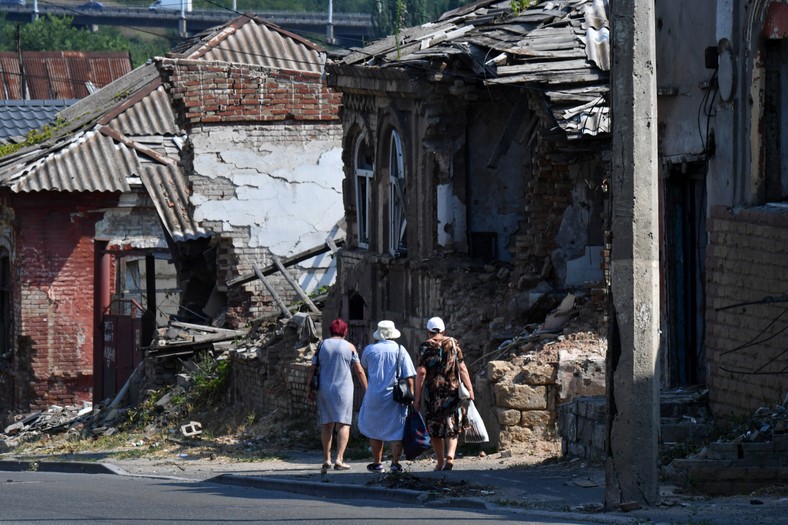
Destruction in Mariupol, 16 July 2025.
At the same time, promotion to the rank of the largest industrial area meant a change in lifestyle and mass Russification of the area. People from all over Russia and later from the Soviet Union came to the hardest work underground. Both Russian tsars and Stalin sent criminals to the mines (as well as political prisoners and prisoners of war) to “change” them through work.
Ukrainian resistance
Many Ukrainian peasants emigrated to America before World War I. They preferred to go through the ocean to work in the countryside in Canada or the United States, rather than move to the city several dozen kilometers away and work hard as industrial workers. Hołodomor, hunger caused by Stalin in 1932-33, was even more decimated by the Ukrainian peasantry in the region.
Now the cities were mostly Russian, and in rural areas – for example in the north of the Lugansk region – was still spoke in Ukrainian or quite a wild mixture of Ukrainian and Russian (with Ukrainian as the basis).
The more amazing is how Ukrainian culture survived in this part of the country. However, many poets, writers and artists are associated with Donbass – either they were born there or spent most of their lives. Even after World War II, writing in Ukrainian and maintaining freedom of the spirit was not completely safe. Many paid for their – even internal – resistance with gulag and even life. Their names have been banned for decades and are largely unknown to Western readers.
The most famous of them is probably the Ukrainian poet Wasyl Stus, who died in 1985 in the Perm-36 camp, after many years of life in Donetsk. The camp was also not survived by the Tyczyj, born in Oleksa, who was against the Russification of Donbass. Ivan Switłyczny and Mykola Rudenko had to serve many years of imprisonment.
“With blue eyes like the sea / and light yellow / slightly faded hair / it is not a flag / it stands in the glass / knee in water / my father” – writes Lubow Jakymczuk. It is not very likely that she will soon be able to return to her hometown. It is extremely important, however, that all politicians of the civilized world strive for this goal.