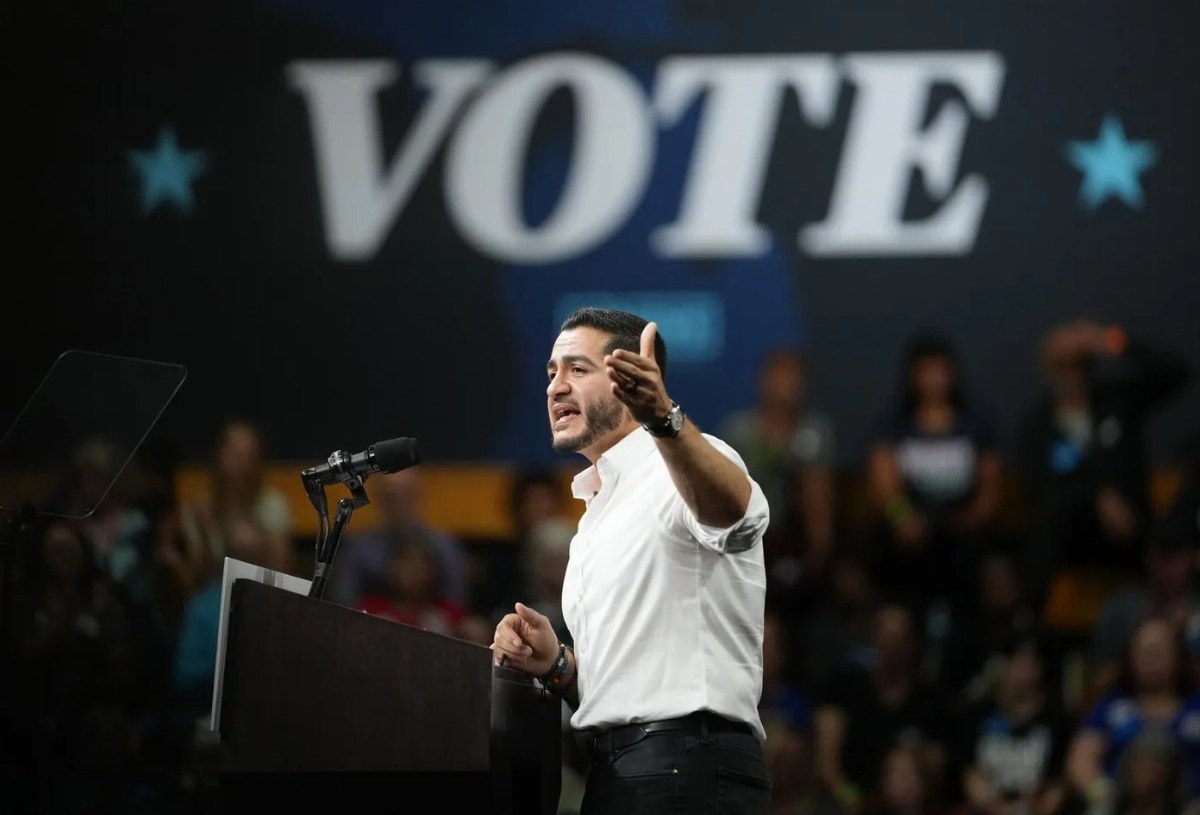
Abdul El-Sayed, a Democrat representing the progressive wing of his party, is set to face Republican Mike Rogers on November 3 for a Senate seat in Michigan. This election has taken on heightened significance, particularly as Donald Trump increasingly engages in a war of words against El-Sayed.
The Senate race could play a pivotal role in determining which party controls the upper chamber of the U.S. Congress following the midterm elections. It will also address two critical questions in the ongoing political and cultural war that has divided the United States.
On one hand, the outcome may reveal whether attacks targeting a Muslim candidate’s identity can be effective. Conversely, it could also indicate how willing Democratic voters are to support the progressive faction of the party, according to reports.
Targeting a Perfect Candidate
Throughout the campaign, Rogers has attempted to frame El-Sayed—who would become the first Muslim senator if elected—as sympathetic to Islamist extremism. El-Sayed has denied these accusations, which his supporters label as Islamophobic.
Rogers additionally claims that El-Sayed’s support for universal healthcare and other progressive policies poses a threat to the United States. This strategy has positioned El-Sayed as an ideal target for Republicans, who have painted foreigners and so-called “left-wing extremists” as America’s primary adversaries.
Background on Abdul El-Sayed
Born on October 31, 1984, in Rochester Hills, Michigan, a suburb of Detroit, El-Sayed is the son of Egyptian immigrants. His father, Mohamed El-Sayed, emigrated from Alexandria, Egypt, to study at Wayne State University, while his mother, Fatten El-Komy, works as a nurse in Missouri.
After his parents divorced in his early years, Abdul was raised by his father and stepmother, Jacqueline Johnson. A former public health official, El-Sayed’s campaign focuses on reducing costs for working-class Americans while attempting to link Rogers to Trump, despite Rogers distancing himself from the president on certain issues in the final weeks of the campaign.
Trump’s Attacks
Trump has labeled El-Sayed as a Muslim extremist and even mispronounced his name intentionally to emphasize the candidate’s foreign roots. Meanwhile, Rogers has sought to associate El-Sayed with the Muslim Brotherhood, a group whose branches have been designated as terrorist organizations by the Trump administration this year. El-Sayed has rejected any connections to the group.
Rogers’ claims are partly based on a 2012 letter signed by El-Sayed and other Egyptian Americans supporting recently elected Egyptian President Mohamed Morsi, who was backed by the Muslim Brotherhood. Additionally, Republican publications, including the New York Post, reference El-Sayed’s mother’s ties to the Brotherhood during her time in Egypt.
Political analysts suggest that such attacks aim to deter Jewish and African American voters in the Detroit area, who previously supported El-Sayed’s primary opponent, Haley Stevens.
Desperate and Malicious Attacks
The Senate seat in Michigan is crucial for both parties in their quest to control the chamber. Republicans currently hold a 53-47 majority in the Senate ahead of Tuesday’s elections, and Democrats need more victories to regain control.
Independent analysts view the race’s outcome as uncertain. Polls from RealClearPolling indicate that El-Sayed leads by 2.5 percentage points in a state Trump won by 1.4 points in 2024.
El-Sayed’s campaign spokesperson, Cole Wozniak, accused Rogers of resorting to “desperate and malicious attacks” and emphasized that the Democrat is focusing on “his plans to reduce costs and combat chaos and corruption in Washington.”
Simultaneously, El-Sayed’s campaign has aired ads portraying him as an ordinary American, featuring his maternal grandmother in the clips.
Rogers’ campaign spokesperson, Abby Ronson, clarified that he does not criticize Islam itself but calls out what he describes as El-Sayed’s adherence to a “radical Islamic agenda.”
An Important Result for Democratic Debate
Advocating for policies aimed at limiting corporate influence and expanding the social safety net, El-Sayed has emerged as a prominent progressive within the Democratic Party. He identifies as a capitalist and rejects the socialist label; however, a victory in November could be seen as a boost for the party’s left wing, which is seeking to solidify its influence ahead of the 2028 presidential elections.
The margin of any potential victory may also be significant, according to political scientist Matt Grossmann from Michigan State University. “If El-Sayed wins by a few points yet trails considerably behind Democratic gubernatorial candidate Jocelyn Benson, this won’t constitute a compelling argument for his faction,” Grossmann stated. “Conversely, if El-Sayed loses, it would be a setback for that faction of the party,” he added.
Rogers’ Strategy
Rogers presents himself as a pragmatic conservative focused on reducing costs, boosting manufacturing, and enhancing border security. Amid declining popularity for Trump, he has recently called for ending the war in Iran and resolving trade disputes with Canada, while avoiding direct criticism of the president.
However, portraying El-Sayed as a threat to national security has also become a key component of Rogers’ final message. Earlier this month, he agreed with a social media post that labeled El-Sayed a terrorist.
Additionally, he appeared alongside Trump at a rally where the president compared El-Sayed to 9/11 attackers, claiming his goal was to keep a “jihadist” out of the Senate.
Ugly and Divisive Tactics
Rogers’ rhetoric has drawn criticism from the NAACP, a nonpartisan civil rights organization that typically refrains from interference in electoral campaigns. Derrick Johnson, the NAACP president, stated, “The blatant racist attacks in the Michigan Senate race are unacceptable and outrageous. These are the same ugly and divisive tactics we have seen used in the darkest chapters of Southern history.”
A survey by the Institute for Public Policy and Social Research at Michigan State University revealed that 38% of voters in Michigan were less likely to support a Muslim candidate.
John Clark, a political science professor at Western Michigan University, noted that the attacks against El-Sayed could serve to discourage Democratic voters but may inadvertently backfire on Rogers, provoking outrage and stimulating voter turnout among the large Arab-American communities in Michigan, particularly in Dearborn and elsewhere. “This might help with some voters, but it has the potential to backfire with others,” Clark remarked.