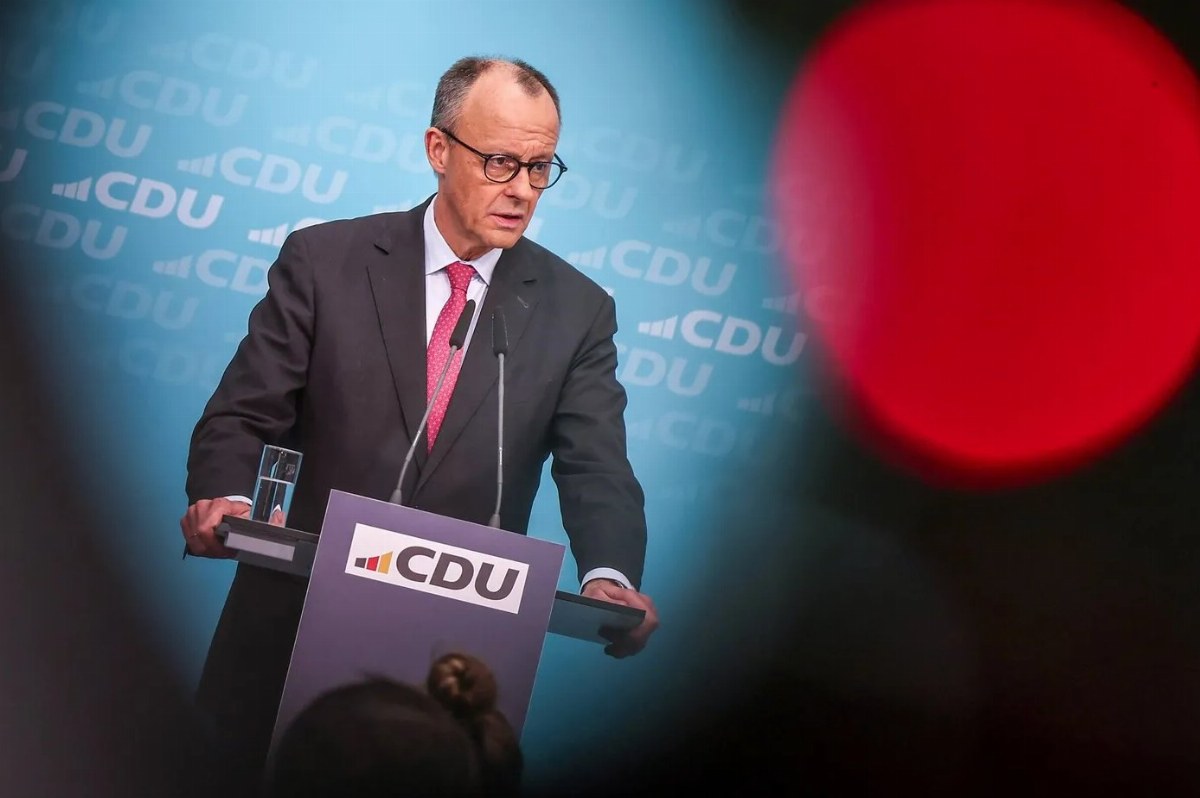
The Chancellor enters the elections in Saxony-Anhalt, along with two other elections on September 20, from a precarious position, as the most unpopular Chancellor in history after 16 months in office. Discussions about his potential replacement have already surfaced in public discourse.
The Alternative for Germany (AfD) is poised to win decisively in the regional elections scheduled for Sunday, September 6, far ahead of the conservatives led by Chancellor Friedrich Merz, according to all pre-election polls.
A victory would be even more resounding for the AfD if the far-right party secures enough votes to gain an absolute parliamentary majority and govern the eastern state independently.
In contrast, the traditional parties, especially Chancellor Merz’s, face a painful day on Sunday, regardless of the outcome.
Increasing Pressure on the Chancellor
If the AfD fails to secure a governing majority—an outcome that seems increasingly likely according to the latest polls—the Christian Democratic Union (CDU) led by Merz, currently in second place, would confront a series of impossible choices in attempting to form a coalition with leftist parties.
Many analysts believe such an alliance would likely be doomed from the start.
Concerns are also mounting that the AfD may prepare for this scenario by contesting the election results on Sunday. The party has already issued press releases questioning mail-in ballots, while its lead candidate, Ulrich Siegmund, has expressed similar concerns on social media.
No matter the results on Sunday, the elections are expected to increase the pressure on Merz and could ultimately lead to his downfall, according to some voices.
In August, Der Spiegel reported that discussions within the CDU about the possible resignation of Chancellor Friedrich Merz have taken place.
“Merz is at an impasse. He can no longer communicate effectively with the party,” a CDU member told Der Spiegel.
Sources cited by the German magazine identified Hendrik Wüst, the Prime Minister of North Rhine-Westphalia, as a potential successor to both the CDU leadership and the chancellorship.
Merz’s Potential Defeat
Chancellor Merz faces the elections in Saxony-Anhalt, and two others on September 20, from a weak position, being the most unpopular Chancellor in history after 16 months in office. Discussions about his possible replacement have already emerged publicly.
Merz has pledged to halt the decade-long rise of the AfD by revitalizing the stagnant economy and limiting illegal immigration, yet he has yet to achieve success.
The AfD continues to lead in national polls.
“If the AfD wins the elections in Saxony-Anhalt, it would represent a personal defeat for Friedrich Merz,” stated Oliver Lembcke from Ruhr University Bochum, as quoted by Deutsche Welle.
“He aimed to cut the AfD’s share of the vote in half. Instead, the AfD has surpassed the CDU, becoming the strongest party—even at the federal level. He bears personal responsibility for this outcome,” the analyst added.
A regional election victory would demonstrate that “the sanitary cordon has failed at the polls—and neither Merz nor his team know how to manage the situation.”
Polling Insights
The AfD has consistently been credited with more than 40% support in Saxony-Anhalt polls, leading the CDU by 10-15 percentage points or more, which currently governs the state in a coalition with the Social Democrats (SPD) and the Free Democrats (FDP).
The chances of the AfD’s main candidate, Ulrich Siegmund, becoming the state’s premier depend on the exact scores of the other parties.
Polls indicate that the FDP is likely to miss the threshold for entry into the regional parliament, but if both the SPD and the Greens exceed the minimum 5% threshold, their votes—along with those of the CDU and the Left Party—could prevent the AfD from forming a government.
With the exception of the small far-left party BSW, which polls suggest has slim chances of surpassing the 5% threshold, all other parties have ruled out the possibility of entering a coalition with the AfD, which, in turn, has stated its intention to govern alone.
Current state premier, conservative Sven Schulze, outpaces Siegmund in voter preferences for the premiership, although it remains uncertain if Schulze can form a government.
An alliance with the SPD and the Greens may not suffice for a majority, and the CDU has ruled out a coalition with the Left Party. The party has not clarified how it could form a majority without their support.
One possibility would be a minority government led by Schulze, relying on passive tolerance from the Left Party. In the neighboring state of Thuringia, a CDU premier in coalition with the SPD and BSW depends on cooperation from the Left Party, which is in opposition, to pass legislation.
Two possible scenarios are on the table.
Scenario 1: AfD Takes Power
If the AfD manages to secure enough votes to govern independently in Saxony-Anhalt, this would represent, in many respects, a simpler and easier outcome for Merz’s conservatives.
Some CDU politicians in the state believe that the AfD entering government would allow them to attack the regional government from the comfort of the opposition benches. They argue that an AfD government would be practically disastrous for the party, effectively “demystifying” their rivals.
“The day (Siegmund) becomes premier, it will be over,” stated Alexander Räuscher, a CDU deputy from Saxony-Anhalt, as quoted by Politico. “He will fail as premier of the state. He will not be able to fulfill all the promises he has made,” he said.
Even so, this scenario still presents significant risks that could hasten Merz’s downfall, as political pressure on him and his conservatives is likely to increase further after the Saxony-Anhalt elections.
The AfD is expected to win regional elections in Lower Saxony as well and is recording strong poll results in the leftist stronghold of Berlin ahead of the elections later this month.
Four more regional elections are scheduled for next year.
CDU deputies fear a major defeat in Saxony-Anhalt could trigger a snowball effect, leading to further significant losses.
There are already signs of open disagreement regarding Merz’s promise to officially avoid cooperation with the far-right, particularly in the eastern part of the country.
“Anyone still talking about the ‘sanitary cordon’ does not understand the signs of the times,” stated Michael Kretschmer, CDU Prime Minister of Saxony in July.
Scenario 2: Conservatives Form a Minority Government
If the AfD fails to secure an absolute majority, this will compel the CDU to attempt to govern together in some form with the other parties—likely all leftist, including the far-left Left Party.
However, Merz’s CDU has ruled out any formal cooperation not only with the AfD but also with the Left Party, which is projected to take third place in the polls.
Thus, the CDU would likely form a minority government with the center-left Social Democratic Party, expected to take fourth place, and possibly the Greens.
However, given the electoral calculations, there would be no clear way to avoid collaboration with the Left Party in some form.
Internal resistance within the CDU against such a configuration is growing. A local CDU faction has already rejected any governing coalition that could survive only with the “goodwill, tolerance, or explicit consent” of the Left Party.
These politicians argue that governing alongside leftist parties actively strengthens the AfD, providing ammunition to portray conservatives as disguised leftists.
This scenario would effectively render Saxony-Anhalt ungovernable. More importantly for national politics, it could fuel the kind of frustration within the CDU that could ultimately lead to Merz’s downfall, according to Politico.
Germans Doubt Merz’s Future
In mid-August, a YouGov poll indicated that a majority of Germans expect Merz to be replaced before the next federal elections scheduled for 2029.
The poll revealed that 36% of respondents expect Merz to stay in office until 2026 but leave before the 2029 elections.
Additionally, 18% believe he will be replaced before the end of this year. Meanwhile, 29% anticipate he will remain in office at least until the next scheduled elections.
Overall, 54% of respondents expect Merz to depart before the end of the current legislature.
A significant majority of respondents stated that Merz has failed to consolidate his authority, despite personnel changes in the cabinet, the CDU parliamentary group, and party leadership undertaken before the summer break.
Approximately 36% indicated he has lost considerable authority within his party, while another 31% believe he has lost some authority.