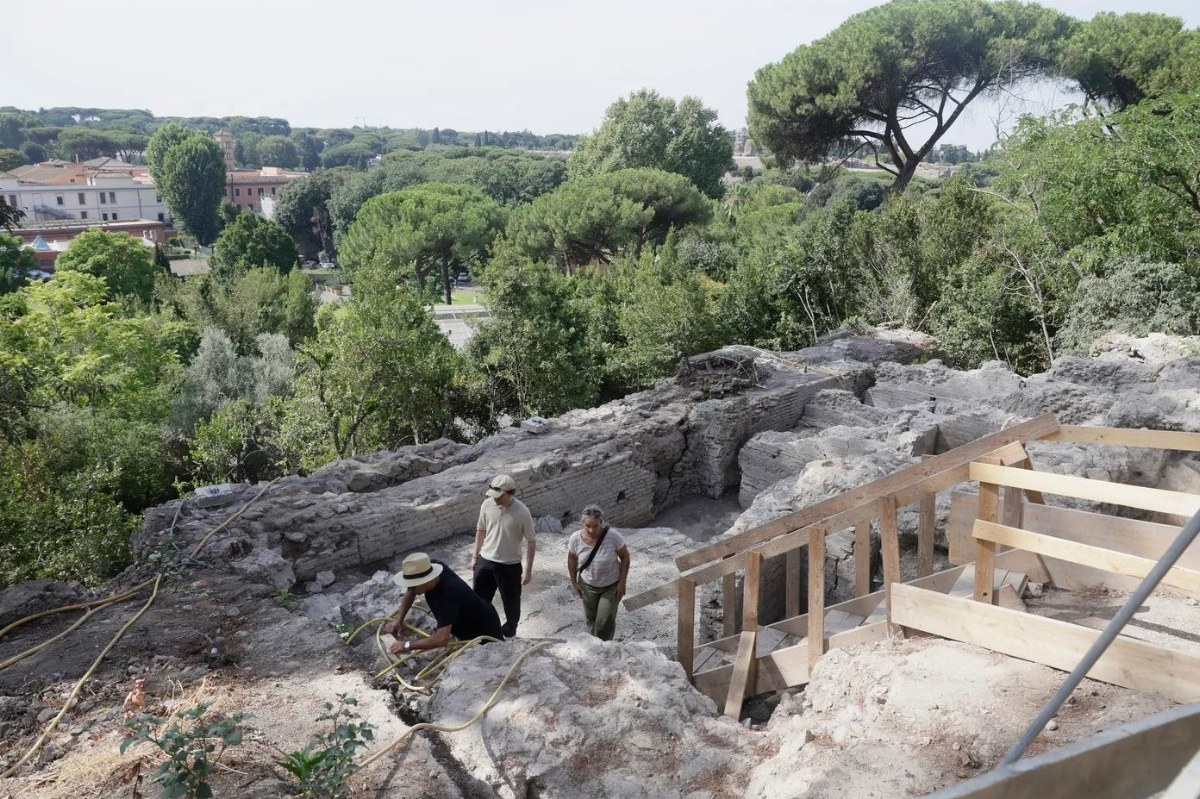
During routine excavation work on Caelian Hill, archaeologists have uncovered a substantial archaeological complex from the 2nd century, adorned with valuable mosaics and frescoes.
The initial project aimed merely to stabilize a wall at Villa Celimontana. However, teams have so far identified eight rooms, five of which have been fully excavated, while the remaining three extend beyond the current excavation area.
Lead archaeologist Simona Moretta noted that although the team anticipated finding ancient artifacts due to the site’s proximity to the Roman Forum, the scale of the discovery exceeded expectations:
“Being in the heart of ancient Rome, just a stone’s throw from the Roman Forum, we certainly took into account the possibility of ancient remains, but not of such significance. We discovered a building with five complete rooms, as well as eight additional rooms whose walls extend into the excavation area that we have not been able to excavate yet.”
Moretta also highlighted the impressive decorations of the discovered structure, particularly in room ‘V,’ where two overlapping mosaics were found—one dating back to the 3rd century AD and the other beneath it from the 2nd century AD.
The excavation teams are currently cleaning and cataloging hundreds of artifacts, including marble fragments, ceramics, mosaics, and painted plaster. Additionally, restorers are reconstructing a richly decorated ceiling retrieved in large sections.
Moretta expressed enthusiasm about the ceiling’s state of preservation, which surpassed their expectations: “We also have several fragments of frescoes, and particularly with the most recently discovered mosaic in this room, we found large portions of the painted ceiling that we have managed to sort with the help of very skilled restorers.”
She added, “We have now stored it, and it will be reconstructed; I believe we will recover over 50% of the entire room. It’s a beautifully painted ceiling with red and blue circles framed by white stucco with dentils.”
This discovery has prompted engineers to expand what was initially planned as a simple stabilization project. Project architect Alessandra Centroni remarked that the excavations quickly grew far more extensive than anticipated.
According to Daniela Porro, the special archaeological inspector for the city of Rome, the complex dates back to the 2nd century AD and was later modified in the 3rd century:
“There are eight rooms, five of which are completely excavated, while three are partially excavated, but they have still revealed valuable decorative elements, including remarkable floor mosaics. One of these rooms features an exceptionally beautiful geometric mosaic, with an emblem depicting a dolphin surrounded by fish around a crater.”
Researchers have yet to determine the original purpose of the building. “It could likely have been a domus belonging to an important family that had such elegant decor, or it could also be a barracks linked to the ancient Roman fire brigade. In this respect, studies are still ongoing and will certainly provide us with more information in the end,” Porro stated.
The excavations are part of restoration efforts funded by Italy’s National Recovery and Resilience Plan (PNRR), backed by the European Union. Archaeologists anticipate that ongoing excavation and conservation efforts will yield new insights into the history of ancient Rome.