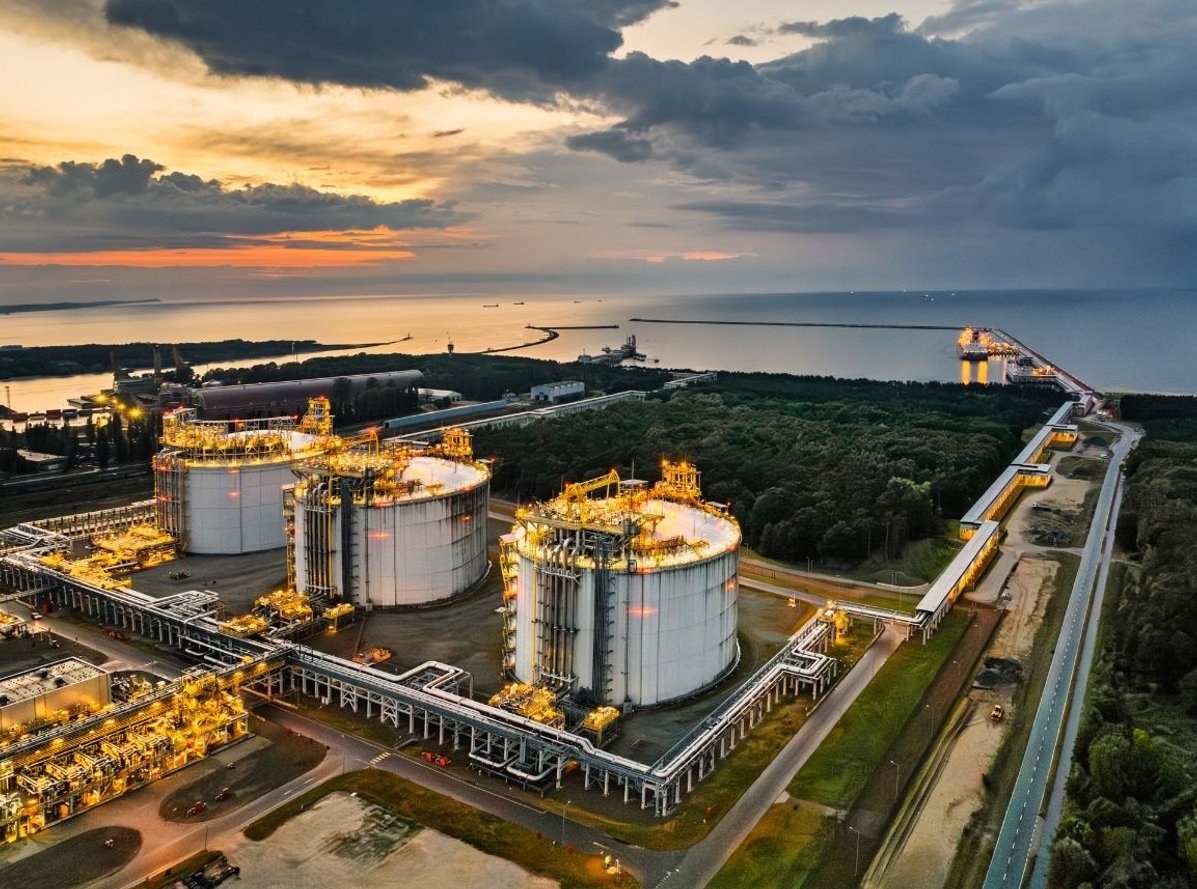
Analysts from the Polish Economic Institute (PIE) predict that Poland’s significance as a liquefied natural gas (LNG) transit country could rise in the coming years. This assessment comes as the government announced plans for a second Floating Storage Regasification Unit (FSRU) terminal in Gdańsk Bay, scheduled to be operational by June 2026.
Once completed, Poland anticipates having three LNG terminals by 2030 with a total regasification capacity exceeding 20 billion cubic meters of natural gas annually. The operational Terminal LNG in Świnoujście has been in service since 2016, and a first FSRU terminal in Gdańsk is projected to commence operations in 2028.
Gas Transmission Capacity Exceeds Demand
Another significant infrastructure development highlighted by PIE analysts is the Baltic Pipe gas pipeline, launched in 2022, which facilitates imports from Norway to Denmark and Poland. Current technical potential for natural gas imports into Poland stands at 32.9 billion cubic meters per year—63% more than the consumption forecast for 2025.
In 2025, Gaz-System noted record gas exports through the domestic transmission system, reaching 2 billion cubic meters annually, with 99% of this exported to Ukraine. However, connections with Slovakia and Lithuania have seen minimal exploitation. Slovakia remains dependent on gas imports from Russia (via Turkstream), while Lithuania has its own LNG terminal.
Poland as a Key Gas Supply Corridor in the Region
Experts believe that with the expansion of LNG infrastructure and cross-border connections, Poland could enhance its role as a regional gas hub and a principal corridor for gas supplies to neighboring countries.