A generation raised on scrolling has started making money on the most offline medium you can think of. Snail mail club works a bit like an analog Substack: instead of another newsletter, you receive a physical shipment once a month.
— In a world where most communication is fast and digital, I wanted to create something that works differently. Something that you have to wait for, but guarantees that someone has devoted their time and attention specifically to us – says Dominika, the creator of the Odręne project, who writes each letter she sends herself.
Snail mail clubs are something between a paper newsletter, a creative club and a craft Patreon. In the US and Canada, the best creators of such clubs have hundreds and sometimes thousands of subscribers. For a one-time fee of $8-10. They can withdraw up to several thousand dollars a month.
See also: Business Insider launches its own podcast. Business and Money
The analog trend is fueled by social media
The creators gain new subscribers in social media – mainly on TikTok and Instagram, where they share the process of packing parcels or printing zines, publish stacks of colorful envelopes and reports of trips to the post office. Then the traffic flows to subscription platforms, such as Patronite or BuyCoffee, or your own stores.
CNBC describes 28-year-old Kiki Klassen from Niagara, Canada, who prepares approximately every month 900 shipments as part of his “The Lucky Duck Mail Club”. Its subscribers receive, among others: typewritten letters, illustrations and stationery accessories. They pay $8 to join the club. monthly. This translates into revenues of over PLN 4.3 thousand. hole. monthly.
The biggest cost remains shipping – up to PLN 2,000. hole. monthly — but still the business maintains a margin of up to 70 percent. Klassen employs only one person: his sister-in-law, who helps with packing.
Read also: An American woman about life in Paris. Things aren't always as magical as she imagined
Trinity Shiroma from Orlando is developing a similar model. Her “The Architecture Club”, built on a passion for architecture, attracts tens of thousands of followers on Instagram. Each month, it sends subscribers materials inspired by specific places – from the Metropolitan Museum to Paris's Café de Flore. Each parcel contains hers original illustration, DIY elements and portion of knowledge about an architectural gem, to which she devoted the new “edition” of the post office. In May, its profit reached over PLN 18,000. hole.
In turn, 26-year-old Bo Natakhin from Toronto transferred this model to the culinary field. His project “Little Kitchen of Bo” is a printed project sent to several thousand subscribers zine with recipesand.
In Poland, the trend is just getting started
Polish snail mail clubs are just starting out. They are smaller, more personal and more strongly embedded in specific communities, but they also take different forms.
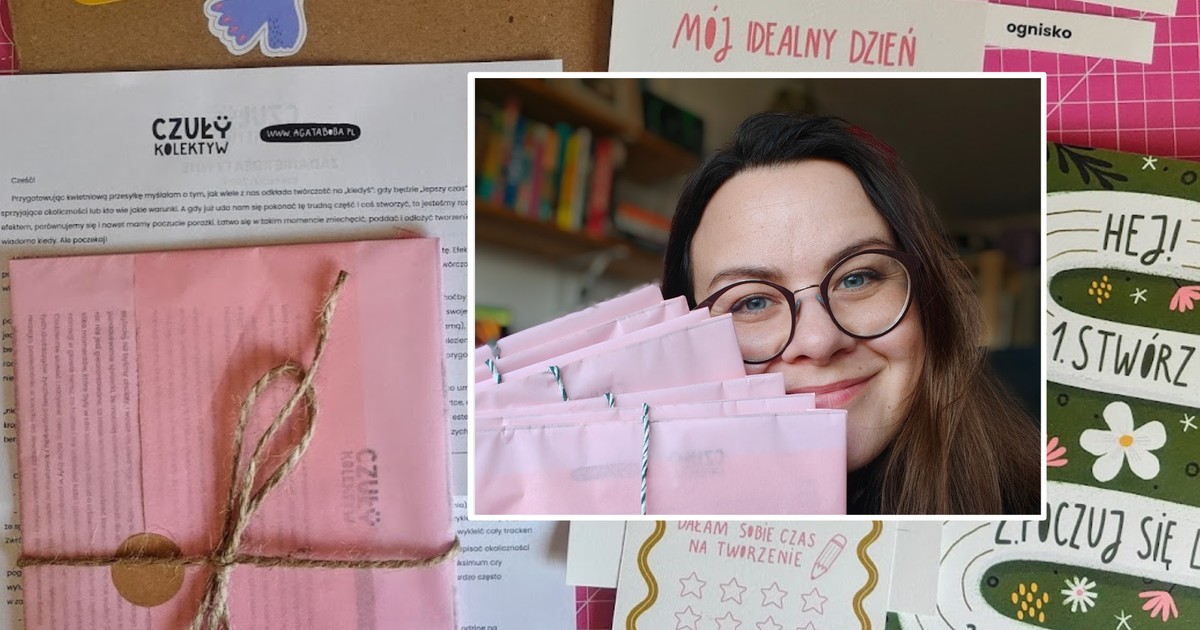
The closest to the classic model is the Handwritten Letters Club, led by Dominika. The main product here remains alone letter – handwrittenpersonal and built around the ritual of opening the envelope. Art Letter Club is more like an artprint club: subscribers receive reproductions of illustrations, stationery accessories and letters from the studio. In turn, projects such as the Sensitive Collective are a ritual in the form of monthly tasks, journaling and sense of community.
— I wanted to create something that would be not only a “product”, but also a small monthly event and a pleasant moment for another person – says Agata Boba, illustrator and creator of the Czarny Kolektyw project. — I really like the idea of a physical package to wait for. Especially since I never reveal what exactly will be inside, so there is an element of surprise. It seems to me that in adult life we really miss such moments of excitement.
Read also: I quit my job before “30” to travel. These are five things I regret today
Each element is designed by Agata
|
Agata Boba / heroine's private archive
As she emphasizes, the project was created as an experiment, but quickly became something more than just another product in the offer of the illustrator who runs her own online store. It is tailored to her and combines things that are important to her both as an artist and as a person.
— There is creativity, there is support for others, there is a friendly community. There is also a lot of my sense of humor and lightness in it. I wanted the relationship between me and the recipients to resemble that of a “friend next door”. Creative tasks are also an important element, because this project is intended to build agency in club members and inspire them to act.. I really like encouraging others to do something their own way, even in small steps, he explains.
Read also: Poles are leaving this country en masse. New data showed the scale
Small scale, big limitations
The scale is definitely smaller. Foreign creators can attract 500 or even 2.4 thousand. subscribers. In Poland, the largest publicly communicated projects operate rather at a high level several dozen shipments per month. It's not enough to make a living, but you can earn some extra money.
Agata emphasizes that the subscription model gives creators something that is often missing in creative work:
— Most creative people live from project to project. There are months when there is a lot of work, and there are also months when things are not so good financially. This is why a model that builds a more permanent and regular relationship with recipients just seemed to make a lot of sense to me. Of course, if I managed to launch the Sensitive Collective on a larger scale, I would be really happy, because it is nice work, she says.
The subscription cost ranges from PLN 30 to PLN 60 per month. At the lower end, shipping alone can cost from one-fifth to even two-thirds of the price, even before the creator counts paper, printing and his own work.. The more “premium” the shipment becomes, the more difficult it is to combine the economics of the entire project. That's why clubs stick to a light, letter format – without heavy add-ons or extensive packages.
— My project has a natural limit because I write each letter by hand. At this point, this limited scale is part of its value – emphasizes Dominika. I think of it more as a limited edition of handwritten letters than a classic subscription that can be replicated endlessly. I started small, but interest is growing, so I'm thinking about how to develop it so as not to lose the heart of this idea. There may be additional, more scalable forms, but the handwritten letter will remain the most personal and important part of this project for me.
Read also: Not coffee and trinkets, but the “big three”. This is where you can save the most
Why does someone pay for a letter from a stranger?
After years of fighting to engage the digital audience, more and more creators are trying to redefine the “attention economy” – based on physical experience, ritual and nostalgia.
According to Dominika, this is the key. The mere fact that someone sat down, wrote a letter and sent it makes us “feel a pleasant warmth inside.” — People miss it. And those who have never received a real letter are just curious what it's like. The return to analog experiences is a broader trend and I believe there will be more and more of it, he says.
The creator admits that from a business perspective it is “not profitable”. — And yet people have this almost primal need to create something. And for me it wins, he adds.
When she started, she didn't know that something like a snail mail club even existed. Over time, the algorithm began to send her foreign accounts and she saw what scale she could reach. However, with hundreds of club members, a handwritten letter would be a task for the staff.
— I realize that people who run snail mail clubs with printed letters are able to outdo me. But it works the same for other crafters. A person making ceramics by hand competes with Pepco, where we can buy a mug for PLN 15, not PLN 150. The question is who cares about what. Ultimately, I have plans to do more than just writing. We'll see what comes of it.