“The Economist” about the Kremlin's secret plan. The US may have a serious problem. We reveal


Now a confidential GRU report, obtained by The Economist through a trusted source, suggests that Russia has offered to provide Iran with jamming-resistant drones and training in how to use them against American soldiers in the Persian Gulf, and perhaps elsewhere in the world.
As “The Economist” found, the Kremlin could offer Iran not only intelligence support, but also modern weapons in sufficient numbers to pose a real threat to American troops and their allies. If these findings are confirmed, it may mean another dangerous stage of the conflict between Russia and the US.
The secret plan involves Russia transferring 5,000 to Iran. short-range fiber-optic drones, similar to those used during the war in Ukraine, as well as an unspecified number of long-range satellite-guided drones.
The document also provides for training in the operation of both types of machines.
The whole thing is contained in a ten-page proposal prepared by the GRU, i.e. Russian military intelligence, with the intention of presenting it to Iran. “The Economist” had the opportunity to read the full document, containing six diagrams and a map showing islands off the coast of Iran.
Intelligence sources in the region who were briefed on the plan found it credible, although they were unable to independently confirm its authenticity.
In late March, Western intelligence officials reported, among other things, that Russia was preparing to provide Iran with its own, improved versions of the Shahid-class long-range drones. Russia originally bought them from Iran in 2022 and began producing them a year later. Russian versions can bypass air defense systems more effectively and carry heavier combat loads, although they do not yet represent a technological breakthrough.
1. A weapon that is difficult to escape from
However, fiber optic drones brought a real change on the battlefield.
In Ukraine, they have led to the creation of huge “gray zones” in which vehicles and soldiers in the open are constantly attacked. Instead of controlling the radio signal — which can be jammed — operators control it via a thin optical fiber that unwinds behind the drone as it flies. This makes extremely precise attacks possible at distances exceeding 40 km.
Russian fiber-optic-guided drones waiting in ambushSpecial Kherson Cat/X
Such drones have also recently appeared in Lebanon, where they were used by Hezbollah – an Iranian proxy organization – to attack Israeli forces. Israeli officials confirm that they were supplied by the Islamic Revolutionary Guard Corps, Iran's most powerful military formation, but did not want to say whether they originally came from Russia.
Fiber optic drones emerged in the 2024 Ukraine war as a response to jamming systems that both sides used to neutralize radio-controlled drones. Russia began using them with particularly devastating effect a year later, when it began mass production.
Although they are less maneuverable than their wireless counterparts, they transmit much higher quality images and do not emit radio signals that could reveal the operator's position.
2. Weapons controlled from orbit
The second part of the secret Russian plan involves providing Iran with long-range satellite-guided drones equipped with Starlink terminals.

Starlink satellite internet terminalYan Dobronosov/Global Images Ukraine via Getty Images / Contributor / Getty Images
The document predicts that access to Starlink could also be blocked there over time, but before that happens, the machines could cause “chaos” in the ranks of American troops.
3. Secret recruitment for Iran
The third element of the plan is training.
The document proposes recruiting drone operators from among approximately 10,000. Iranian students studying at Russian universities. Other potential recruiting groups would be Tajiks – who speak both Russian and Persian – and the Alawite minority in Syria, loyal to the ousted regime of Bashar al-Assad.
According to the proposal, all candidates would undergo a detailed verification in terms of loyalty and possible links with religious extremism.
Secret scenario of war with the USA
The content of the GRU report suggests that it was written at a time when the main threat to Iran seemed to be the possibility of an American naval landing aimed at opening the Strait of Hormuz or capturing the island of Khark.
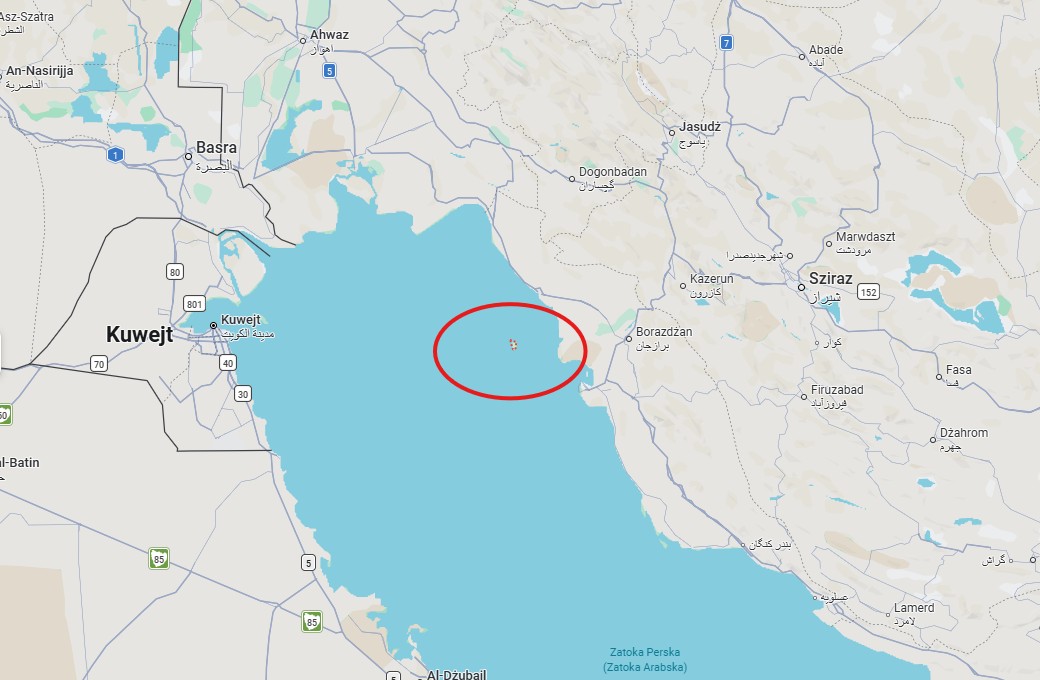
Khark Island is located in the Persian GulfGoogle Maps / Press materials
The document emphasizes that American landing units would be particularly vulnerable to drone attacks due to their low speed.
One diagram shows how Russian-trained Iranian operators could attack an amphibious flotilla by launching swarms of five or six drones from hidden positions about 15 to 30 km away. Although the scenario of an American landing on Iran now seems very unlikely, earlier in the war it raised serious concerns among both Russian and Iranian officials.
The GRU document also notes that Russia is deeply committed to the fifth year of its “special military operation” in Ukraine. This limits the resources it could devote to helping Iran.
The proposal also emphasized that greater Russian involvement in the conflict with Iran would involve political and military risks. At the same time, even limited support could significantly hamper a possible American operation.
Moreover – as the document notes – this assistance could remain officially “unprovable”, which would avoid Russia being directly drawn into an open conflict with the United States.
© The Economist Newspaper Limited, May 7, 2026