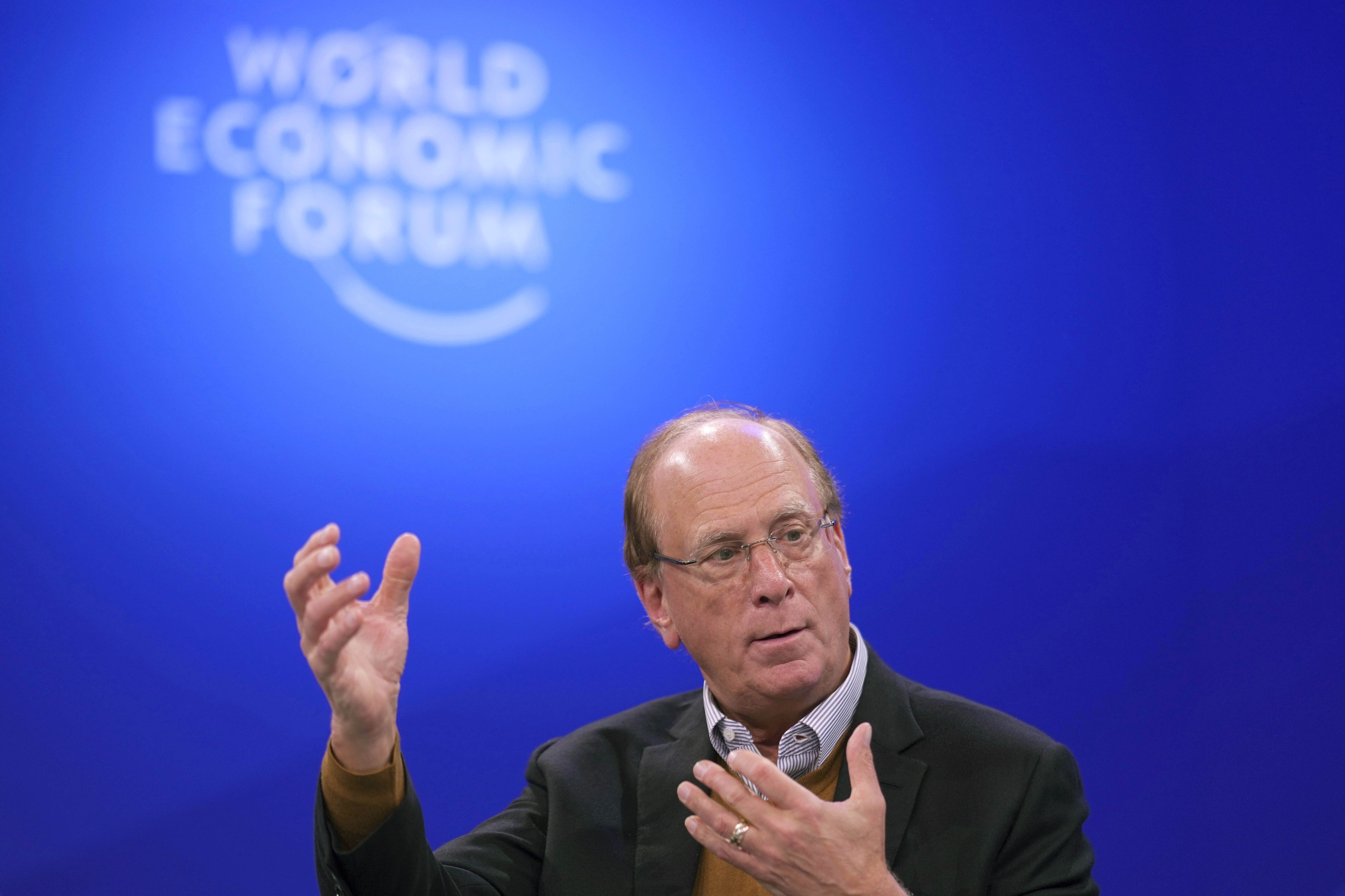
If the price of oil reaches $150 per barrel, it will trigger a global recession, Larry Fink, director of the American financial giant BlackRock, told the BBC.
Fink, who runs the world's largest asset manager, said if Iran “remains a threat” and oil prices remain high, it will have “profound implications” for the global economy.
BlackRock is a financial colossus, controlling $14 trillion (£10.5 trillion) in assets and is one of the biggest investors in many of the world's biggest companies.
The conflict in the Middle East has triggered sudden moves in financial markets as people try to understand what will happen to energy costs.
Fink advanced two scenarios: first, in which the conflict is resolved and Iran becomes a country that can be accepted by the international community again, in which case the price of oil could fall below pre-war levels.
But if not, he says, then there could be “years of oil above $100, closer to $150, which has deep implications for the economy” and will lead to a “severe and steep recession.”
Fink says countries need to be pragmatic about their energy mix, using all available sources, but providing cheap energy is essential to boosting economic growth and raising living standards.
“Rising energy prices is a very regressive tax. It hits the poor more than the rich.”
Although the UK already has solar and wind power, as well as hydrocarbons, if oil prices rise to $150 for three or four years, “we could see many countries moving rapidly to solar and wind power.”
Countries should not depend on a single source, he says.
“Use what you have of course, but also aggressively look to alternative sources.”
“Zero similarities to 2007-2008”
Some analysts have suggested that there are some echoes of the run-up to the 2007-2008 financial crisis in the markets at the moment.
Energy prices are rising, and some companies have reported signs of cracks in the financial system. BlackRock is one of the firms that has limited capital withdrawals from private equity funds by worried investors.
But Fink is adamant that there is no chance of a repeat of the financial trauma of 2007-2008, when several banks around the world collapsed or had to be bailed out, because he believes financial institutions are safer today.
“I don't see any similarities,” he says. “Zero.”
The problems affecting some funds are a small part of the overall market, and institutional investing remains strong, he says.
Fink also rejects suggestions that the surge in investment in artificial intelligence, which has led to billions of dollars of investment in the new technology, has been exaggerated.
“I don't think we have a bubble at all,” he says.
“Could we have an AI failure or two? Sure, I agree.”
Last year, BlackRock was part of a consortium that bought one of the world's largest data center providers, Aligned Data Centers, in a $40 billion deal.
“I think there's a race for technology dominance. I think if we don't invest more, China is winning. I think it's imperative that we aggressively develop our AI capabilities.”
The biggest problem that, in his opinion, is preventing the expansion of artificial intelligence in the US and Europe is the cost of energy.
While China is investing heavily in solar and nuclear power, in Europe “I just see a lot of talk and no action,” he says, while in the U.S. “as energy independent as we are, we'd better start focusing on solar power … because we need cheap and inexpensive energy to move to artificial intelligence.”
“AI will create jobs for plumbers and electricians”
Earlier this week, in his annual letter to shareholders, Fink said the AI boom risks deepening inequality, with only a small number of firms and investors seeing the benefits.
However, in a statement to the BBC, he stressed that artificial intelligence will create “an enormous number of jobs”.
He said in his letter he mentioned how many jobs would be created “related to electricians, welders and plumbers”.
Conversely, there may not be as much demand for some office jobs as AI evolves, and this could lead to a rethinking of the roles required as “society changes and evolves”.
In the US, he says, after World War II, “we laid the foundation for education and told all the young people: go to college, go to college, go to college. And I probably overdid it.”
“We have to balance that and we have to be proud that … a career can be just as strong in the fields of plumbers and electricians.”