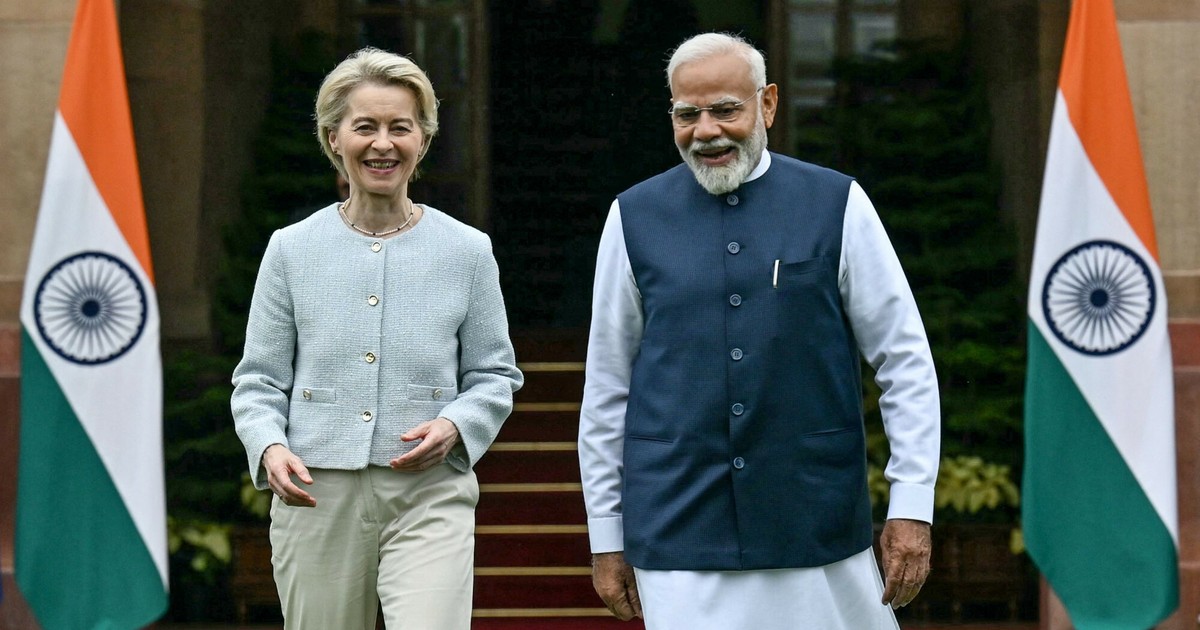
— The Free Trade Agreement (FTA) between the European Union and India is almost ready and will be finally agreed on January 27 during the visit of the President of the European Commission, Ursula von der Leyen, and the President of the European Council, Antonio Costa, in New Delhi, Indian officials said in recent days. Shortly after announcing the agreement of member states to the controversial agreement with the South American bloc Mercosur, the EU is joining another major trade treaty. What is it intended for?
The rest of the article is below the video:
Read also: The European Union is negotiating with India. A new trade agreement soon
Almost 90 percent growth
Negotiations on an EU-India agreement abolishing mutual trade barriers were first initiated in 2007, but six years later the disagreement of both sides as to the shape of the agreement led to the suspension of the talks. It was resumed in June 2022, and the current stage looks like it is coming to an end, with only a few issues left to be determined. Importantly for both European and Indian farmers, unlike the Mercosur agreement, the agreement will not cover agriculture, but will focus on industrial goods and services.
According to data provided by the European Commission, over the last decade, trade contacts between the EU and India have increased by almost 90%. The exchange includes, among others: products such as chemicals, textiles and base metals imported to Europe, or transport equipment, electrical machines or plastics exported to the Indus and Ganges.
The full list of goods is much longer. IN 2024, the EU was responsible for 11.5%. Indian trade turnover, and India for 2.4 percent. EU turnover. According to the consulting company International Economics Consulting, Europeans are investing in India, among others: in the IT sector and financial services, but also in the expansion of road and railway infrastructure. In turn, Indian players in the EU help develop industries such as biotechnology, logistics, metallurgy, but also IT.
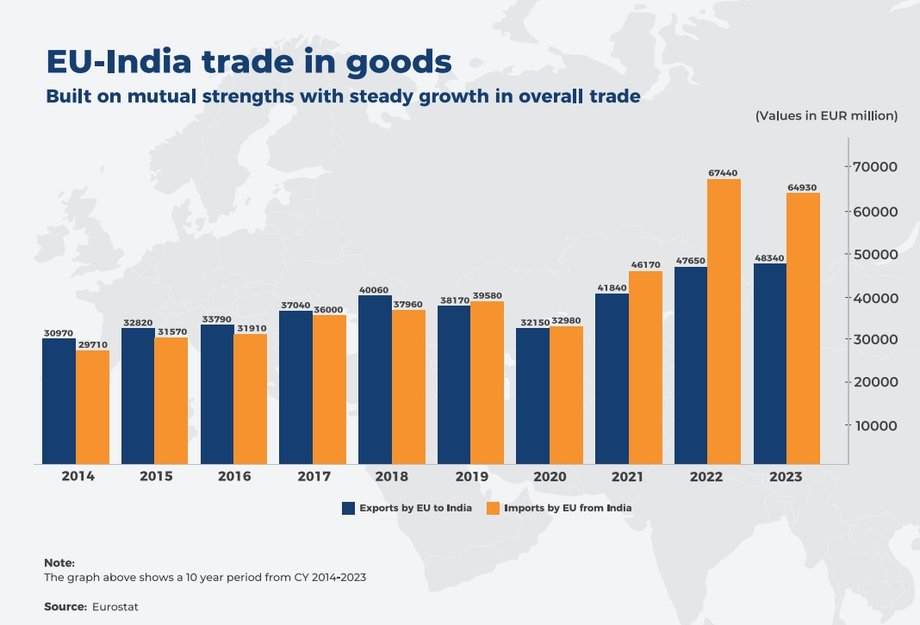
EU-India trade exchange
|
European External Action Service / European External Action Service
“It's a scale incomparable to anything else”
European interest in closer economic cooperation with India is easily explained. – We are talking about a country with a population of approximately 1.5 billion. This is a scale incomparable to anything else, which allows us to reduce costs and creates huge opportunities for cooperation, says Dr. Patryk Kugiel, chief analyst in the Asia-Pacific program of the Polish Institute of International Affairs.
– This is a large, not fully explored and very absorbent market, which is important not only from an economic but also a strategic point of view. Europe wants India to have closer ties with the West, since the alternative is its alliance with China and Russia – explains the specialist.
He adds that such a large partner as India is more important for the EU than Mercosur, where the population reaches approximately 290 million. However, the potential needs to be unlocked.
— India's policy today is clearly protectionist. The import of products such as cars is subject to duties of approximately 100 percent. In the case of alcohol, it is up to 150 percent. Therefore, the opening of the local market depends on, among others, European automotive industries – explains Dr. Kugiel.
“We have to offer something in return.”
Despite limited possibilities, in 2024 the value of bilateral trade between the European Union and India amounted to approx. 120 billion euros. Trade in services reached half of this amount.
– For the EU, India is the ninth largest partner in the world, accounting for less than 2.5 percent. international trade. However, for India we are in first place. Gradual lowering and abolition of barriers thanks to the new agreement can only multiply today's values - argues the expert.
Which sectors of the European economy can particularly benefit from this? In addition to the automotive industry, Dr. Kugiel mentions the arms industry – particularly important for the geostrategic reasons mentioned earlier.
— India is the world's largest arms importer. If we don't want them to buy it in places like Russia, we have to offer them something in return. This is already starting to happen – after Chancellor Friedrich Merz's recent visit to New Delhi, Germany concluded a contract with India for the sale of six submarines. The French, in turn, sell their leading fighters, i.e. Rafale – the specialist gives examples.
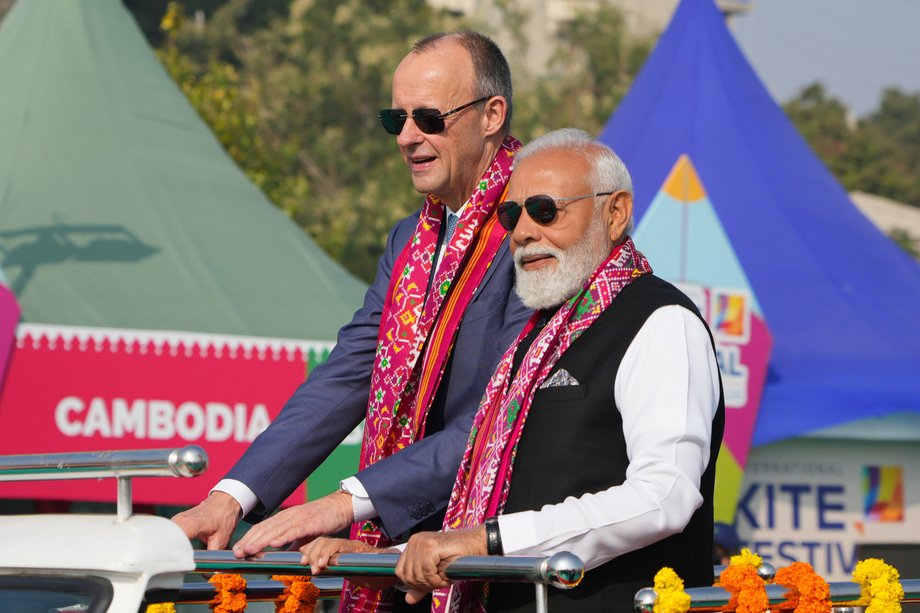
German Chancellor Friedrich Merz and Indian Prime Minister Narendra Modi on January 12
|
Ajit Solanki/Associated Press/East News/East News
“Do business and protect the planet”
The agreement is also intended to be an opportunity for the European green technology sector, currently weakened or threatened by competition from China.
— India is one of the fastest growing photovoltaics markets in the world. If Europeans want to rebuild their own production in this area, they may find attractive customers there, says Dr. Kugiel. Wind energy in India is less developed, but as we hear, European companies are also looking at New Delhi with “huge interest” in this respect. The same applies to electromobility.
Cooperation in the area of energy and climate may also include India's production of green hydrogen, which Europe needs primarily in the decarbonization of certain sectors of energy-intensive industry or maritime or air transport.
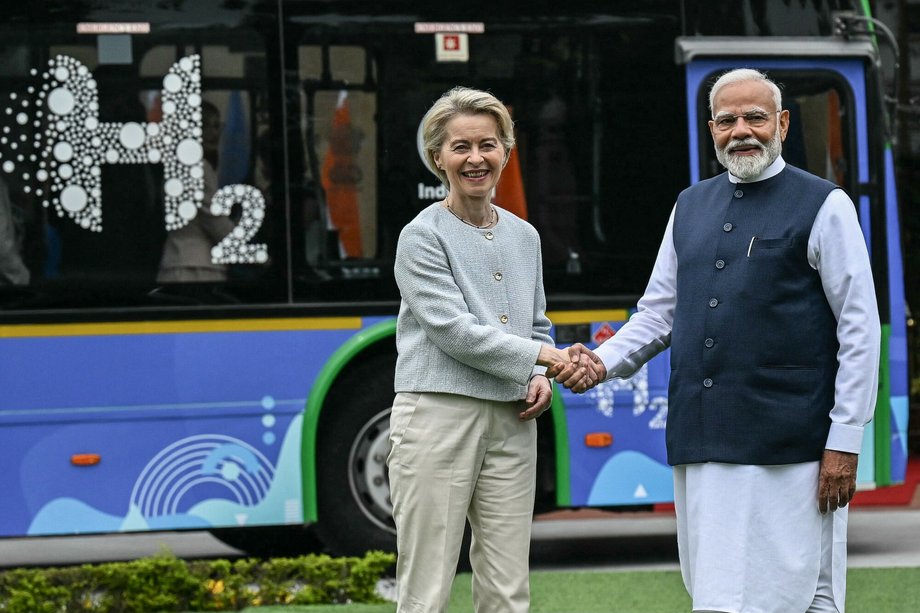
European Commission President Ursula von der Leyen and Indian Prime Minister Narendra Modi next to a hydrogen bus, February 28, 2025
|
MONEY SHARMA/AFP/East News / East News
– India's economy relies heavily on coal. It is the third largest emitter of CO2 in the world, but over time it will aim to reduce emissions, which will be helped by carbon capture and storage technologies – our interlocutor lists further technologies. As he says, as Europe we have common interests with India – “do business and protect the planet from destruction“The agreement should also enable closer research and scientific cooperation.
Read also: New industry and the fight for competitiveness. What was driving climate policy in 2025?
– The French nuclear sector is also very interested in the Indian market – not only in terms of building large-scale power plants, but also small modular reactors – he continues.
Polish-Indian conquest of space?
How can Polish business find its way in all this? Dr. Kugiel admits that at the moment our trade or investment relations with India are not well developed.
— Before we develop them, the main benefits for Polish companies from the free trade agreement between the EU and India may consist mainly in our connection to European supply chains. The role of a supplier to the German economy, especially in the automotive and machinery industries, although it does not meet all our ambitions, may pay off in this case, he argues.
Read also: Polish industry is asking for support. There is an appeal to Minister Domański
Nevertheless, several more promising areas for strengthening Polish-Indian ties can already be identified. The expert is talking about improving mining efficiency or exporting from Poland equipment used in conventional energy – boilers and turbines. In addition, there are the green technologies already discussed. – Our entrepreneurs should not miss these opportunities – warns a representative of PISM.
– Poland can also cooperate with India in the field of space exploration. Last year, astronauts from both countries took part in one mission — the specialist recalls the joint flight of Sławosz Uznański-Wiśniewski and pilot Shubhanshu Shukla from the Indian Space Research Organization.
The emission tax is here to stay
Although, according to our interlocutor, the overall balance of the agreement will be definitely beneficial for Poland, including the EU, individual industries may lose from it.
— Every free trade agreement has its winners and losers. The role of the state is to provide some forms of support and protection for sectors that will be negatively affected, says Dr. Patryk Kugiel.
The Polish ceramics industry is afraid of competition from India, which can win thanks to, among others, lower labor costs, but also less restrictive climate and environmental standards. The steel industry also has concerns, including steel producers, whose imports are constantly increasing.
As Dr. Kugiel reminds, a certain security for these industries is CBAM (Carbon Border Adjustment Mechanism) – a carbon border tax in force from the beginning of 2026, which is intended to prevent the unfair advantage of foreign products with a higher carbon footprint but not subject to emission fees.
=Everything indicates that the CBAM contract will remain in force. During several years of negotiating the contract, this was one of the most controversial points; The Indians were very keen for the EU to eliminate these regulations, and although we don't know the details yet, the EU got its way — says the expert.
“The political will is enormous”
We'll learn more about the deal when it's announced on January 27 – or later. As Dr. Kugiel reminds, precise provisions on the degree of tariff reduction for individual sectors, possible excluded quotas or other protective measures may still be negotiated.
— After the agreement enters into force, we will still have a transition period, so there is still some time before its full impact. However, the political will on both sides to conclude the treaty is enormous. A year ago, during her visit to New Delhi, Ursula von der Leyen announced that the negotiations would be completed by the end of 2025, so there is a slight delay, but January 27 seems to be a realistic date – sums up the specialist. Like the treaty with Mercosur, the agreement with India will also require acceptance by the European Parliament and member states.