Previously, on October 26, Epiphany visited Filaret and congratulated him on the occasion of the 30th anniversary of his enthronement.
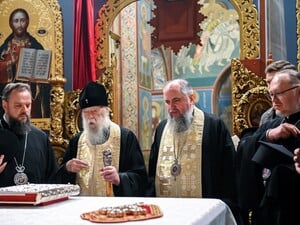
At the meeting, where in addition to Epiphany and Filaret, three other metropolitans and Archbishop Agapit of Vyshgorod were present, they talked about the challenges of Russian aggression and the situation in the temporarily occupied territories of Ukraine.
At it, everyone noted that “the use of the Ukrainian language in worship is the cornerstone of its development and approval,” the OCU informed.
“Metropolitan Epifaniy noted that the achievements of the church have become a solid foundation that no enemies can destroy,” the statement said.
The OCU said that Filaret was presented with a letter of gratitude from Epiphanius on the occasion of the 25th anniversary of the consecration of St. Michael’s Golden-Domed Cathedral.
Next, in St. Michael’s Golden-Domed Cathedral, a joint prayer was held for the victory of Ukraine over the Russian aggressor and the advent of a just peace, and Filaret blessed those present at the prayer.
Context
On December 15, 2018, the OCU was created at the unification council, which was attended by all the bishops of the UOC-KP and the Ukrainian Autocephalous Orthodox Church, as well as two bishops of the UOC of the Moscow Patriarchate. On January 5, 2019, Ecumenical Patriarch Bartholomew signed the tomos of autocephaly of the OCU, and on January 6, he presented it to Metropolitan Epiphanius in Istanbul. Epiphanius's enthronement took place on February 3, 2019.
Soon a public conflict arose between the new church and Filaret. According to Filaret, Epiphany was supposed to represent the church in the world, and Filaret was supposed to handle internal affairs, but this agreement was allegedly violated. After this, Filaret stated that the Kiev Patriarchate had not been liquidated and suggested the separation of the UOC-KP from the OCU. Epiphanius said that it is wrong to talk about the restoration of the Kyiv Patriarchate, since this could lead to the isolation of the OCU, depriving it of the tomos of autocephaly and “all the achievements of church independence.”
On June 20, Filaret held a meeting of a group of hierarchs in the Vladimir Cathedral, which he called a “local council.” At the meeting, they adopted a resolution on the restoration of the UOC-KP and refused to accept the tomos. The OCU called these decisions “insignificant in the legal and canonical sense of the word.” Filaret continued to insist that the UOC-KP, which he headed before the unification council, did not dissolve itself.
Recently, Filaret, who is now 96 years old, has been ill. In October, he drew up a will in which he asked that his funeral service be performed by someone other than the OCU, and called for work to create a unified Ukrainian Orthodox Church, independent of both Moscow and Constantinople.