The Kremlin has stepped up its airstrikes with drones and guided bombs, boosting combat performance ahead of the vulnerable winter season, analysts note. The Russians continue their slow but steady advance on the battlefield, and as long as they are making gains, they have no incentive to stop hostilities on the current front lines, as Donald Trump recently called for, ahead of new peace talks, CNN reports.
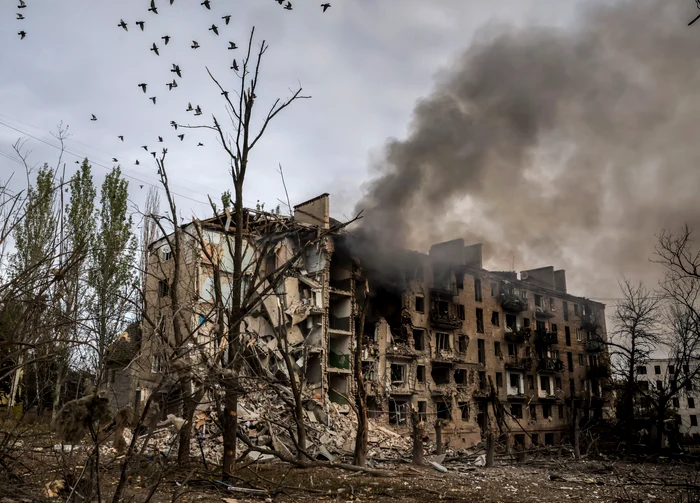
The front-line town of Kostiantinivka destroyed by bombing PHOTO EPA-EFE
On Friday, Russia launched a record 268 aerial guided bombs, according to the Ukrainian military, compared with a daily average of 170 to 180 in recent weeks. These bombs, which carry a payload of up to 1,500 kilograms, mostly target Ukrainian forces and infrastructure near the front lines.
In parallel, Russia continues nightly drone and missile bombing of civilian areas, particularly targeting energy infrastructure. In September alone, the Russians launched an average of over 180 drones per night, more than twice as many as at the beginning of the year.
Recently, Ukrainian officials admitted that about 20% to 30% of these drones evade air defenses.
In the last week alone, Russia has attacked with 3,270 drones, 1,370 guided aerial bombs and almost 50 missiles of various types, Volodymyr Zelensky said on Sunday.
Improved attack methods
“Moscow has developed new methods of using drones to identify and kill Ukrainian soldiers and destroy Ukrainian assets, turning what was once a weakness into a strength,” Russia analyst Dara Massicot wrote in Foreign Affairs.
At the same time, it “built better missiles and created more robust and capable armored systems. It gives junior commanders more freedom to plan,” says the analyst.
Pressures on several portions of the front
In the northern Kharkiv region, the Russians are putting pressure on the defense of the city of Kupiansk, advancing north and east of the city, which has been under attack for more than a year.
War Gonzo, a well-known Russian blogger, announced on Telegram on Saturday that fighting was also taking place in the city center.
About 80 Russian soldiers have infiltrated Kupiansk, the Ukrainian military admitted on Thursday. Ukrainian defenders are “doing everything in their power to clear it of Russian invaders and prevent the build-up of enemy infantry.”
This Russian tactic “could lead to control of the city (if reinforcements can arrive and consolidate their positions),” Ukrainian blogger Bohdan Miroshnikov wrote, adding that the situation is very complicated but that “occupation of the city is still a long way off.”
Also in the Kharkiv region, but closer to the border, the Russians gained ground near the town of Vovceansk, including the capture of a nearby village.
Then, on the eastern front, in the Donetsk region, heavy fighting continues around the city of Pokrovsk. In this sense, on Saturday, a Russian military blogger wrote that Russian troops are advancing towards the northwestern outskirts of the city.
On the other hand, the Ukrainian army claims to have recovered about 180 square kilometers of territory in the Pokrovsk area in the past two months, following counterattacks.
Oleksandr Sârski, the head of the Ukrainian army, insisted on Friday that the Russians do not have “the strategic initiative. At the cost of huge losses, the enemy has made only minor advances in certain sections of the front.”
“Ukrainian fighters stopped the enemy's spring-summer offensive campaign,” he emphasized.
On the other hand, Russian forces have gained more than 300 square kilometers of territory in the past four weeks, about half of what it seized in the previous four weeks, according to Harvard University's Belfer Center for Science and International Affairs.
Huge costs for Russia
These advances come at a high cost in terms of soldiers for Russia: Nearly 14,000 Russian soldiers have been killed or wounded in the Pokrovsk area alone since the end of August, according to Ukraine's military command. The figures cannot be independently verified.
Faced with these losses, the Russian defense ministry is making changes to how it recruits additional personnel. In recent weeks, Russian regions have begun reducing generous enlistment bonuses designed to attract new recruits.
The practice is likely only producing the results of the past “which could force the Kremlin to adopt an alternative approach,” according to analysts at the Institute for the Study of War (ISW), which monitors developments on the battlefield.
“Russia may begin mobilizing members of Russia's active reserve on an ongoing basis to support its combat operations in Ukraine,” according to ISW.
Ukraine's strategy is more long-range, relying on long-range attacks on the Russian energy infrastructure that fuels its ability to wage war. In this regard, it is developing its own production of cruise missiles to increase its offensive capability. In parallel, it lobbies allies to obtain powerful weapons such as Tomahawk missiles.
Since the beginning of the year, the Ukrainians have carried out successful strikes against 45 facilities in Russia's fuel and energy sector, according to Sîrski. Industry analysts estimate that a fifth of Russia's refining capacity has been affected by deepwater attacks.
“Ukraine cannot destroy Russia's war-fighting capability, while Russia appears incapable of defeating Ukraine militarily,” according to a recent analysis by Russia Matters.