The day when the Romanians were in the hands of the Russians. 300 years ago they dreamed of occupying the principalities and turning them into military action basis


The Russians put their eyes on the Romanian principalities for almost three centuries. In fact, the territory of Moldova and Wallachia was repeatedly invaded by the Russian troops and at the Peace Conferences of the country they insistently demanded the definitive attachment of the Romanians at the Tsarist Empire.
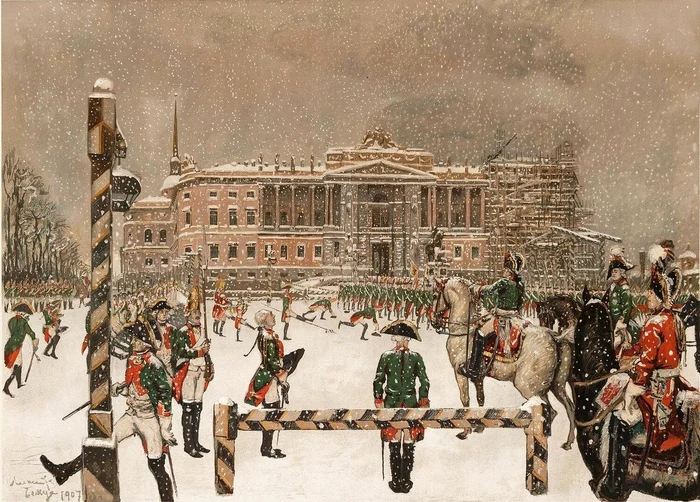
Parade of the Russian Army Photo Wikipedia
At the beginning of the eighteenth century, during the reign of Peter I the Great, Russia officially became a great European power. It was a period marked by reforms but also by the resounding Russian victories, such as those in the Great Nordic War (1700-1721) culminating with the transformation of Russia into an empire in 1721. Peter the Great modernized the army, administration and economy, integrating Russian territories into the European Statal System. The countries that followed them, for the most part, tried to continue this modernization and turn into a marginal and partially backward country into one of the largest players in European politics. In this approach, the interests of the Russians were hit by those of the Ottomans.
The Tsarist Empire, Emerging, tried to win the territories and prestige on account of the increasing weakness of the Ottoman Empire, a “huge clay legs” that had lost, in the eighteenth century, step with the modern world, remaining a medieval complain. That is why there were numerous wars between the Russians and the Turks. In the economy of these conflicts, the Romanian Principalities played a very important strategic role. They were the vassal of the Ottoman Empire but they had very rich and important resources and moreover, they had an extremely favorable position from a strategic point of view. This is why the Russians put their eyes on Moldova and Wallachia. That is, they wanted to occupy them and integrate them into the empire. In this way they came to have the Danube control and access to all the Ottoman provinces in the Balkans. We are not talking about the resources they could use from the Romanian territories.
When the Tsar's men began to behave like masters
In the third decade of the eighteenth century, during Empress Ana, the Russians officially stated the express claim to annex the Romanian Principalities, as a strategic point. These claims appeared during the Russo-Austro-Turkish war of 1735-1739. Initially, the war started between the Russians and the Turks. The conflict came out after the Russians were involved in the war for the succession of Poland but also in Persia. In addition, the Russians wanted to expand their territories to the Black Sea to the detriment of the Crimean Hanat, the ally of the Ottoman Empire. The Russians equipped and endowed their army by Western model. They even benefited from French and German commanders. The most important was the Burkhard Christoph von Münnich, eager to see, on the skin of the Turks, the effects of his reforms in the Russian army.
It was a wear conflict, especially in the Crimean area but which quickly expanded on the territory of Bessarabia today but also of the Romanian Principalities. In the war, the Austrians also entered, as allies of conjunction of the Russians, against the Ottomans. Both Moldova and the Romanian Country were taken to the meadow by the Austrians and Russians. Each one wanted to occupy one territory or another. The Austrians expressed their claim to annex the entire Wallachia. In fact, the Habsburg armies also occupied parts of Oltenia and Muntenia. The Russians were even worse, they wanted, no more, no less of both principalities, the border of the Tsarist Empire to reach the Danube directly. In fact, the armies of the Feldmareșal von Munnich entered Moldova and occupied it. The Germans arrived in the service of Tarina Ana, has already begun to behave like a master in Moldova. The threat, gave orders and gave the people free to prey to the left and right. He even allowed him to ask for huge amounts of money to the Moldovans.
“The Hotin was forced to capitulate on August 31, 1738, after which the Russians began to pass the Prut, making requisitions in the Dorohoi, Cernăuţi, Hârlău and Suceava lands. At the beginning of September, the Russian avant-garde arrived near Iasi, Mr. Grigore Ghica being forced to withdraw. It was installed in the capital of Moldova, behaving as a true ruler of the country. Through a convention concluded on September 18, 1738 with the couch of the country and under the threat with the plunder of the whole of Moldova, Muennich imposed the following conditions: the Moldovans to be faithful “with all the heart” of Russia; Moldovans should not have links with the enemies of Russia; The Moldovan boyars privileges to return in a year, to benefit from amnesty, and those who refused not to be forgiven; Moldova to maintain a Russian army of 20,000 people33, for guard and order in the country's settlements; Moldova to give 3,000 salaries, annually, for working at the fortresses; Moldova to take care of the hospitals of the Russian army; Russian officers of the 20,000 soldiers to be provided with all the need; no stranger to access the governors; the boyars and servants of Moldova who do not serve in the administration to serve in the army and to be paid by the state, but to pay the gifts to the state; 90 bags of money to be handed to Muennich “now”; 100 bags of money to be given to Muennich “in all years”; Nobody to evade from the payment of the arranged, in money or in supplies, because otherwise “with their head they will give”stated Laurențiu Chiriac in the “Romanian countries and the influence of the Russo-Austro-Turkish war of 1735-1739”, for the acta Moldaviae Meridionais. The rescue came, the peak, from the Turks. They managed in one way or another to win the war with the Austrians. Following the peace of Belgrade, the Principalities remained under Ottoman suzerainty.
Romanians the exchange currency of the French. Give on the hand of Napoleon Russians
However, other Russian and Austrian employers of the Principalities followed. Following the Russian-Turkish war of 1768-1774, concluded with the peace of Kuciuk-Kainargi was inaugurated the Russian protectorate on the Principalities. The Romanians escaped the protective power of the Russians only after the Crimean War, in the fifth decade of the 19th century. That is, after almost a century. However, the Russian countries were not satisfied with the protectorate, but they always insisted on the effective incorporation of the Principalities in the Russian Empire. For example, following the Russo-Austro-Turkish war of 1787-1792 the idea of the “Dacian Plan” was resumed to unify the two Romanian countries, in one state but under a Russian dynasty. This time our luck of conjunction were the Austrians.
The Habsburgs also coveted at least a piece of the Principalities and categorically opposed the Russian claims. In order not to wake up with enemies from two parts, the Russians were forced to swallow in the century. But they did not give up the idea of occupying the Romanian Principalities and will resume it on different occasions throughout the early 19th century. There was an almost fatal time for Romanians. This is the Congress from Erfurt where, officially, the Romanian Principalities were given to the Russians, even by Napoleon. Itself, between September 27 and October 14, 1808, in the town of Erfurt, in Thüringen, the center of Germany, the famous meeting between Napoleon, the emperor of France and the most powerful man on the European continent, with his great rival, the Tsar of Russia Alexander I.
“In addition to the French and Russian emperors, the majority of the German sovereigns were present. The latter, however, were not in Erfurt to participate in the” Prince Congress “, as it was often called, but to complete the extended court of the two protagonists. Most of these princes who were in a hurry at the blind show in Erfurt were a little more than spectators, at most minor actors at the summit between the two powerful emperors who had divided Europe in 1807 “said Michael Kerautret in “The Meeting of Erfurt”. This meeting that occurred the treaty from Tilsit in 1807, was an attempt by Napoleon to approach the Tsar of Russia, in the hope that he will be able to isolate Austria and peacefully Spain.
He pressed Alexander I to firmly declare himself ally of Napoleon against Austria and thus discourage any vague attempt of aggression from the latter. The peak, just Talleyrand, the great French man advised Alexander I to refuse, convinced that Napoleon was carrying the country. At Erfurt, Napoleon wanted more than anything to hold the Tsar of Russia against the United Kingdom, while Alexander I, sought to achieve Napoleon's neutrality in terms of the Ottoman Empire. What interests us is the fact that in Erfurt, officially, the Romanian Principalities were given to the Russians. This time no one opposed these plans. “As for Turkey, Napoleon had resigned beforehand to keep his provinces Moldova and the Romanian Country, which is sanctioned by Article 8 of the Treaty. However, it was decided that the annexation would be postponed to maintain the appearances.”said Michael Kerautret in the same article. In fact, this aspect is also stipulated in the final act of the Congress from Erfurt.
“His Majesty the emperor of all the Russians, following all the revolutions and changes that disturb the Ottoman Empire and which leaves no possibility to give and, consequently, no hope of obtaining sufficient guarantees for the persons and assets of the inhabitants of the Romanian Country and Moldova, after having already taken the limits of his Empire and to the Romanian Empire. This condition to recognize the integrity of the Ottoman Empire, Emperor Napoleon recognizes the called Union and the called limits of the Russian Empire, extended to that side to the Danube ”, is shown in point 8 of the official act of the Congress.
For his part, the Minister of Foreign Affairs, Talleyrand, wanted the Romanian Principalities to reach Austrian rule precisely to arouse a rivalry between Russians and Austrians. And this time the rescue came providential. Specifically, Napoleon and Tsar Alexander I broke the shabby friendship and returned to the war. So the Russians were satisfied only with Bessarabia, in 1812. Until 1878, the Russians tried to annex the Romanian Principalities. They even kept them under military occupation from 1829 to 1834, Russian generals supervising the politics of the Principalities. Each time, the Romanians were lucky, either by the great powers that did not see with good eyes the expansionist tendencies of Russia, or by the geopolitical changes that threw the Russians' plans.